Jump to a section
Buy GLOW peptide: vial or prefilled pen
Choose between a 70 mg powder vial and a 150 mg prefilled pen. Both combine GHK-Cu, BPC-157 and full-length TB-500 at a 5:1:1 ratio. The difference is the total amount, preparation and how the liquid volume is measured. [2]
Online ordering is not available yet.
GLOW 70 mg vial
50 mg GHK-Cu + 10 mg BPC-157 + 10 mg TB-500. Fixed 5:1:1 blend.
- Form
- Blue freeze-dried powder
- Preparation
- Reconstitution required
- Sealed storage
- −20°C (−4°F) · dry · dark
- Documented lot
- PL-2609-043
Source report for the sampled powder lot.
GLOW 150 mg prefilled pen
3 mL prefilled · 50 mg/mL nominal concentration · same 5:1:1 blend.
- Ingredients
- 107 / 21.4 / 21.4 mg, rounded
- Solution
- Water + 0.9% benzyl alcohol
- Preparation
- Already mixed
- Storage
- 2–8°C (36–46°F) · do not freeze
Powder-lot COA shown for reference. It does not test the finished pen.
Research-labelled products. Drawings show the formats; they are not product photographs.
GLOW 70 mg vial — 50 mg + 10 mg + 10 mg
One freeze-dried vial contains 50 mg GHK-Cu, 10 mg BPC-157 and 10 mg TB-500. The three ingredients are already blended. There is no need to buy separate vials to recreate that ratio. [1]
The powder needs dissolving before a liquid volume can be measured. A final 2 mL volume gives 35 mg/mL; a final 3 mL volume gives about 23.33 mg/mL. The same vial contains the same 70 mg at either volume. Adding more liquid changes concentration, not the amount of peptide.
Each 3.5 mg mathematical portion contains 2.5 mg GHK-Cu, 0.5 mg BPC-157 and 0.5 mg TB-500. The vial contains twenty such portions before preparation losses or discard limits. That is a quantity comparison, not a treatment schedule.
The supplied lot is PL-2609-043. Its source report identifies all three ingredients and gives 99.72% combined HPLC area purity. The blue cake is consistent with the copper complex, but its colour alone cannot verify identity or strength. [1]
GLOW prefilled pen — 150 mg in 3 mL
The pen is already mixed at a nominal 50 mg/mL. Its 3 mL cartridge contains 150 mg total blend by label arithmetic. The solution contains water and 0.9% benzyl alcohol; do not add water to the cartridge. [2]
The listed ingredient amounts are 107 mg GHK-Cu + 21.4 mg BPC-157 + 21.4 mg TB-500. They sum to 149.8 mg because the component figures are rounded; the nominal total remains 150 mg. The pen uses the same 5:1:1 ratio as the 70 mg vial. [2]
The pen has about 2.14 times the vial's total content. It does not contain a different set of peptides or an additional skin ingredient. The convenience difference is that the solution is prepared and held in a pen cartridge.
At the stated 50 mg/mL, a 3.5 mg total amount corresponds to 0.07 mL. That number is a volume calculation, not a dial instruction. The product information does not give the liquid volume per click, so a click count cannot be calculated from cartridge size alone.
The redacted powder-lot COA appears beside this format for reference. No finished-pen content, sterility or stability report was supplied, and the pen's exact batch linkage to the powder report is not confirmed.
What changes between the two formats
| Detail | 70 mg vial | 150 mg pen |
|---|---|---|
| Total blend | 70 mg | 150 mg nominal |
| GHK-Cu | 50 mg | 107 mg, rounded |
| BPC-157 | 10 mg | 21.4 mg, rounded |
| TB-500 | 10 mg | 21.4 mg, rounded |
| Ratio by mass | 5:1:1 | 5:1:1 |
| Mixing | Powder needs reconstitution | Already in solution |
| Concentration | Depends on final volume | 50 mg/mL nominal |
| Extra solution ingredients | Depend on specified diluent | Water + 0.9% benzyl alcohol |
| Documented testing | Named powder-lot COA | Same powder-lot reference; no finished-pen report |
One millilitre is not one milligram. For example, 0.1 mL of a 70 mg vial prepared to 2 mL contains 3.5 mg total blend. The same 0.1 mL of the pen's nominal 50 mg/mL solution contains 5 mg. Copying a volume between formats changes all three ingredient amounts.
The physical format also does not establish which option works better. There is no human trial comparing these GLOW products. The documented differences are their contents, preparation, liquid concentration and testing scope. [2]
GHK-Cu, BPC-157 and full-length TB-500
GHK-Cu
The GHK peptide bound to copper. It supplies five of every seven milligrams in this blend. The labelled amount is the whole copper–peptide complex.
BPC-157
The sequence identified on the report is the same BPC-157 ingredient used in the single-peptide guide. The GLOW vial supplies 10 mg.
Thymosin beta-4
The supplied TB-500 is full-length, N-acetyl thymosin beta-4. The lot report identifies a molecular mass of 4963.7 Da.
All three change together
Increasing a portion increases GHK-Cu, BPC-157 and TB-500 together. The blend cannot lower one ingredient while keeping the other two unchanged.
The certificate identifies each molecule by LC-MS. Some other products called TB-500 contain a shorter seven-amino-acid fragment; the shared name does not make those materials identical. This product's report specifies the full chain. [1] [3]
70 mg GLOW, 150 mg GLOW and 20 mg Wolverine Stack
The 70 mg GLOW vial has the same BPC-157 and TB-500 amounts as the 20 mg Wolverine Stack vial: 10 mg of each. The extra 50 mg is GHK-Cu. The higher number on the front does not mean seven times as much BPC-157 as a 10 mg BPC-157 vial. [1]
For an equal 3.5 mg amount of this GLOW formula, the ingredient split is identical in the vial and pen. The liquid volume differs because the concentrations differ. Compare the amount of each peptide first, then the liquid volume needed to represent it.
GLOW labels from other formulations can use different ratios. A 50 mg blend with 35 mg GHK-Cu, 5 mg BPC-157 and 10 mg TB-500 has a 7:1:2 ratio, not this product's 5:1:1. Its calculator and ingredient totals cannot be copied unchanged. [2]
Wolverine Peptide product comparison → · GLOW amounts and course totals →
Compare price per milligram
Divide the price by the total blend content: vial price ÷ 70 mg, or pen price ÷ 150 mg. This compares the nominal amount of the same 5:1:1 formula. It does not price in preparation materials, pen convenience, delivery or unused material.
| Comparison | Calculation |
|---|---|
| Cost per mg, vial | Vial price ÷ 70 |
| Cost per mg, pen | Pen price ÷ 150 |
| Equal cost per mg | The pen price is 150 ÷ 70, or about 2.14 times the vial price. |
If the pen costs less than 2.14 times the vial, its nominal blend cost per milligram is lower. If it costs more, its cost per milligram is higher. Live prices and ordering links are not available on this page, so neither product is labelled the cheaper option.
GLOW storage: powder and liquid
−20°C / −4°F
Keep dry and protected from light. The certificate's September 2028 retest date belongs to the stored powder lot.
2–8°C / 36–46°F
Keep protected from light. Store the pen in its original carton and do not freeze it. No verified number of in-use days was supplied.
The pen solution is normally clear blue to blue-violet. Its storage instructions say to discard it if frozen, cloudy or changed from its normal colour. A normal appearance does not measure how much active ingredient remains after poor storage. [2]
The sealed-powder retest date cannot be used as an expiry date for a mixed vial or opened pen. Adding a preservative also does not create a documented months-long use period. Follow the format's actual storage and use limit.
Redacted GLOW certificate of analysis
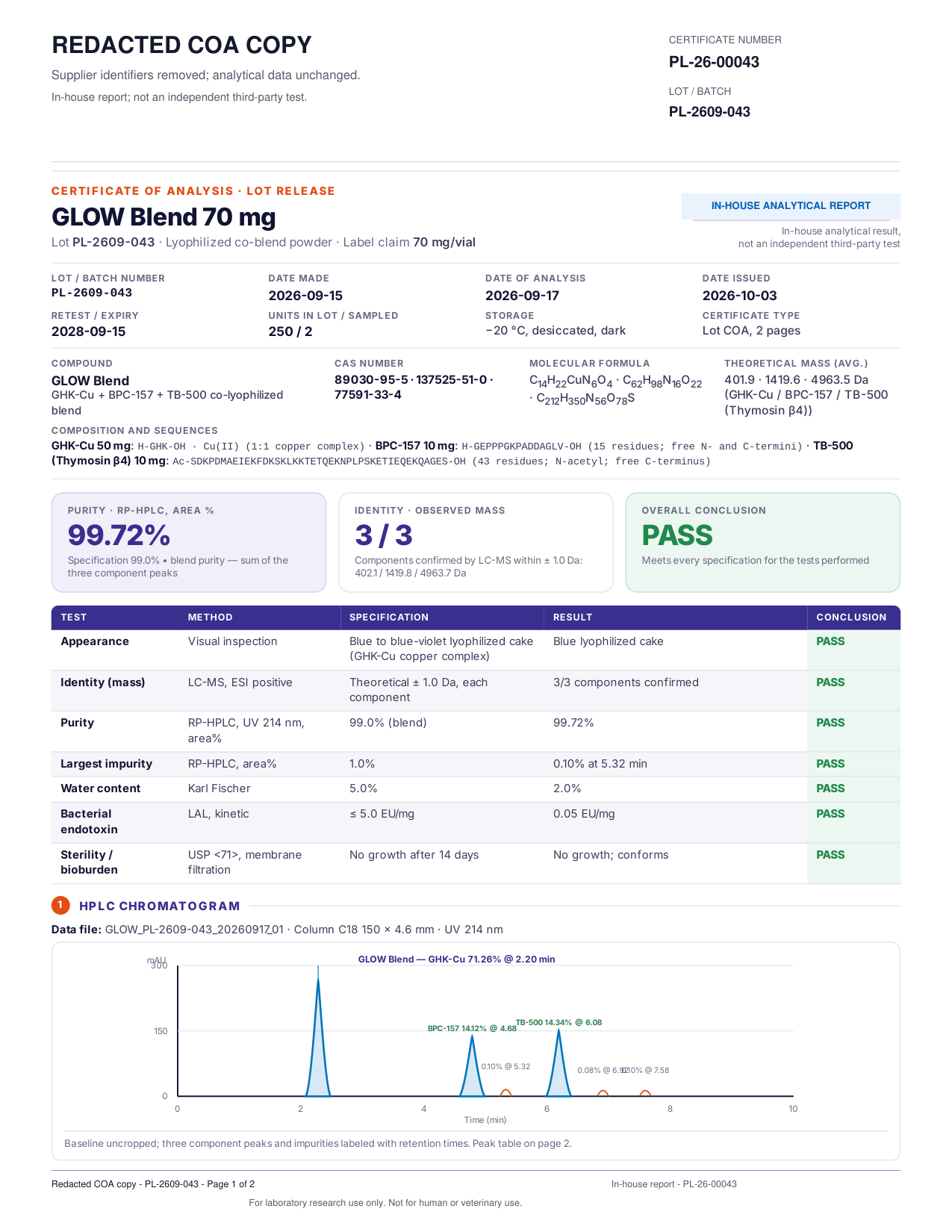
GLOW blend — powder lot PL-2609-043
Two sampled units of the named powder lot. HPLC area purity is not a fill-content assay. Shown with both formats; no finished-pen test or batch linkage is supplied.
Open redacted COACertificate PL-26-00043 covers powder lot PL-2609-043. Two units were sampled from a 250-unit lot. The listed tests were performed in-house; the document does not attach an independent laboratory report. [1]
| Test | Recorded result |
|---|---|
| Ingredient identity | All three components identified by LC-MS. |
| Combined HPLC area purity | 99.72% from the three component peaks. |
| Endotoxin | 0.05 EU/mg. |
| Sterility test | No growth after 14 days for the tested samples. |
| Water content | 2.0% by Karl Fischer. |
| Analysis and issue | Analysis: 17 September 2026. Issued: 3 October 2026. |
Purity and fill amount are different measurements. The report's peak-area percentages are not a separate quantitative assay of 50 mg, 10 mg and 10 mg in each vial. They also do not establish the pen's finished concentration, sterility or delivery per click.
The same redacted PDF is linked beside both products, with its powder-lot scope stated. Open the report to see both pages, the lot identifier, methods, results and release signatures.
Questions & answers.
Is this a 70 mg or a 150 mg GLOW product?
There are two formats: a 70 mg freeze-dried vial and a 3 mL pen labelled 50 mg/mL, giving 150 mg nominal total. Both use a 5:1:1 ingredient ratio.
Why do the pen ingredients add up to 149.8 mg?
The listed amounts—107 mg, 21.4 mg and 21.4 mg—are rounded. The nominal label total is 150 mg; neither figure is a finished-pen assay result.
Does the pen need mixing?
No. The peptide blend is already dissolved in the cartridge. Do not add water to it.
Does one pen contain the same amount as two vials?
Slightly more by nominal label total: one pen contains 150 mg, while two 70 mg vials contain 140 mg. Actual usable yield depends on losses and the applicable discard limit.
Are the three ingredient amounts adjustable separately?
No. In this fixed blend, all three amounts rise or fall together. The pen and vial both retain the same 5:1:1 ratio.
Is the COA independently tested?
The supplied document identifies in-house testing. It gives results for two sampled powder vials and does not attach an outside-laboratory report.
Does the COA test the finished pen?
No. The same redacted powder-lot report is available beside the pen for reference. A finished-cartridge assay, sterility result and exact lot linkage were not supplied.
Are needles and mixing supplies included?
The vial listing identifies one sealed powder vial. The pen specifications describe a prefilled cartridge in a pen with a fitted needle. Additional needles, diluent and other accessories are not confirmed; do not assume an extra pack is included.