Jump to a section
Wolverine Stack = BPC-157 + TB-500
Wolverine Stack combines BPC-157 and TB-500 in one blend. It is used as a name for the pairing, whether the ingredients arrive in one vial or in separate products. The two-peptide combination is studied for joint pain and tissue repair; it is not a single new peptide.
The supplied powder vial contains 10 mg BPC-157 + 10 mg TB-500: 20 mg in total. Its TB-500 is full-length thymosin beta-4, a 43-amino-acid peptide. The attached certificate identifies both ingredients. [1]
TB-500 can refer to different molecules. This lot contains the full 43-amino-acid thymosin beta-4 chain. A seven-amino-acid fragment is also sold under that name; the name alone does not identify the ingredient. [1] [12]
A 20 mg blend is not 20 mg of each peptide. That distinction changes every concentration and volume calculation. Open the blend calculator →
How Wolverine Stack works
BPC-157 and thymosin beta-4 affect cell movement and tissue repair through different processes. BPC-157 research focuses on how repair cells survive stress and move through damaged tissue. Thymosin beta-4 research also examines the rebuilding of the material around those cells.
Repair-cell movement
BPC-157 increased tendon-cell movement and survival under stress. It activated FAK and paxillin, two proteins involved in cell attachment and movement. The experiment did not show faster cell multiplication. [10]
Tissue remodelling
Thymosin beta-4 increased enzymes that remodel the tissue surrounding cells during wound repair. Its actin-binding region contributed to that effect. [11]
These are findings from cells and animals. Two repair mechanisms do not automatically produce a better combined result: in the Achilles-tendon experiment, adding the peptides together did not outperform either alone. [3] Combination results versus single-ingredient results →
Wolverine Stack benefits
Less knee pain
Pain improved in 3 of 4 patients after BPC-157 and thymosin beta-4 were injected into the knee. [2]
Tendon repair
Better tendon-tissue scores after surgical repair. The combination did not outperform the individual ingredients. [3]
Muscle recovery
Improved movement and strength after a severe quadriceps injury. This experiment tested BPC-157 alone. [4]
Skin-wound repair
Faster wound closure and new tissue formation in an animal wound study. [5]
Wolverine Stack versus BPC-157 alone
Wolverine Stack adds TB-500; it does not double the amount of BPC-157. The supplied 20 mg Wolverine Stack vial contains 10 mg of BPC-157, the same labelled BPC-157 amount as a 10 mg single-ingredient vial. The other 10 mg is TB-500. [1]
| Option | What changes |
|---|---|
| BPC-157 alone | One peptide. Its amount can be changed without changing TB-500. |
| Premixed Wolverine Stack | Both peptides in each portion. This vial fixes the mass ratio at 1:1. |
| Separate BPC-157 + TB-500 | Two products allow different amounts or frequencies. A premix cannot copy a schedule in which only one ingredient is taken on a given day. |
The blend has not been shown to be a stronger treatment than BPC-157 alone. The small knee-pain series had only four combination recipients and was not a randomized comparison. The rat Achilles experiment used a different ingredient ratio from this 1:1 vial. [2] [3] Exact knee-pain results →
Capsules containing only BPC-157 are not an oral version of the Wolverine Stack blend. Both ingredients, their amounts and their delivery route need to match before two products can be treated as equivalents.
Daily dosage
500 mcg BPC-157 + 500 mcg TB-500, once daily for four weeks. [6]
20 mg ÷ 1 mg = 20 portions before losses. A portion is a quantity calculation, not a recommended dose.
Other documented amounts and schedules →
500 mcg of the blend contains 250 mcg of each ingredient. To describe 500 mcg of each, the total must be 1,000 mcg. A fixed 1:1 blend also delivers TB-500 every time it delivers BPC-157; it cannot reproduce daily BPC-157 with twice-weekly TB-500. Daily amounts, frequency and preparation →
Cycle length
Four weeks is the cycle length in the 1 mg daily example. A four-week period contains 28 days, so the arithmetic is 28 mg total: 14 mg of each ingredient. Two 20 mg vials contain enough material for that calculation, before waste or any discard limit.
Finishing a course does not confirm that an injury has healed. Cycle examples and material totals →
Wolverine Stack vial and pen
Wolverine Stack 20 mg vial
10 mg BPC-157 + 10 mg TB-500. Fixed 1:1 blend.
- Form
- Freeze-dried powder
- Preparation
- Reconstitution required
- Sealed storage
- −20°C · dry · dark
- Documented lot
- PL-2609-011
COA for the sampled powder lot.
Wolverine Stack 3 mL prefilled pen
Both ingredients already in solution. No powder mixing.
- Form
- Prefilled liquid cartridge
- Peptide strength
- Needs confirmation
- Solution
- 0.9% benzyl alcohol
- Storage
- 2–8°C · do not freeze
Strength conflict: 20 mg combined in the title; 20 mg of each in the specifications. Confirm the current pen label before calculating an amount.
Redacted batch COASame supplied blend-lot COA. It does not test the finished pen.
Research-labelled products. Drawings show the formats; they are not product photographs.
The vial gives a confirmed ingredient split. The pen removes powder mixing. The pen documents conflict: 20 mg combined in the title, but 20 mg of each ingredient in the specifications. Confirm its strength and dial calibration before calculating an amount.
A format changes handling and measurement. It does not establish better absorption, faster recovery or a stronger clinical effect. Compare preparation, storage and the redacted COA →
Results and recovery time
Less pain, more movement
BPC-157 first, then TB-500 added after two weeks. [9]
No added combination benefit
30 daysThe combined group did not gain an advantage over either ingredient alone in the tendon experiment. [3]
Shoulder and elbow timelines, clinical results and nonresponse →
Adding BPC-157 or TB-500 to Wolverine Stack
Wolverine Stack already contains both ingredients. Adding a separate BPC-157 product raises only the BPC-157 portion; it does not keep the original 1:1 balance.
| Arithmetic example | BPC-157 total | TB-500 total |
|---|---|---|
| 1 mg of a 1:1 Wolverine Stack blend | 500 mcg | 500 mcg |
| That blend + 500 mcg separate BPC-157 | 1,000 mcg | 500 mcg |
These sums identify overlap; they are not suggested combinations. For the single ingredient, use the BPC-157 guide. For the comparison between a fixed blend and separate schedules, use Wolverine Stack dosage.
Side effects
Injection-site irritation
Nausea
Headache or tiredness
Skin or gum darkening
Irritation, nausea and headache/tiredness appear in a clinic’s guidance. Skin and gum darkening appears in an FDA-described BPC-157 + TB-500 adverse-event report. [7] [8]
Redacted Wolverine Stack COA
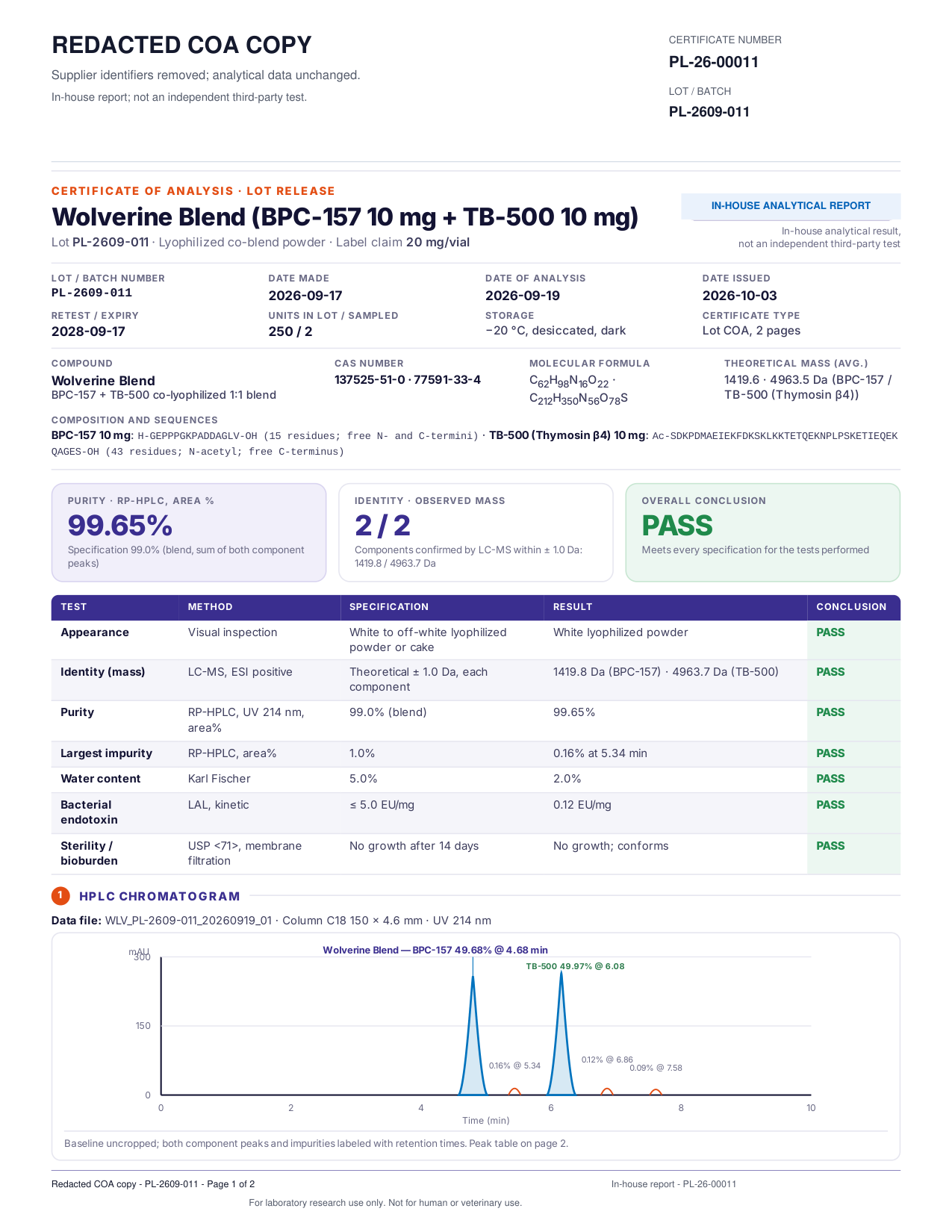
Wolverine blend — powder lot PL-2609-011
Named freeze-dried blend lot. HPLC area purity is not a separate fill-content assay. Shown with both formats; no finished-pen result is supplied.
Open redacted COAThe same source report accompanies the vial and pen comparison. Its sample is freeze-dried blend from lot PL-2609-011. It contains no separate finished-pen concentration, device-delivery or stability result. Full test breakdown and product scope →
Questions & answers.
What is Wolverine Peptide?
Wolverine Stack is the pairing of BPC-157 and TB-500. The supplied powder vial contains 10 mg of each, for 20 mg total.
Is Wolverine Stack the same as BPC-157?
Wolverine Stack contains BPC-157 plus TB-500. A BPC-157-only product has no TB-500 unless the ingredients explicitly include it.
How much of each ingredient is in 1 mg?
In the supplied 1:1 blend, 1 mg total contains 0.5 mg BPC-157 and 0.5 mg TB-500: 500 mcg of each.
Is the pen the same strength as the vial?
The vial is confirmed at 20 mg total. The pen documents disagree: the title says 20 mg combined in 3 mL, while the specifications list 20 mg of each. Its actual strength must be confirmed before a concentration or click conversion can be made.
Does the COA cover both formats?
The same redacted COA is provided beside both formats. It tests a named freeze-dried blend lot; it is not a finished-pen test report.
Can a blend copy a separate BPC-157 and TB-500 schedule?
Only when the ingredient amounts and frequency match the fixed blend ratio. Every portion of a 1:1 blend supplies both peptides together, in equal mass.
Is TB-500 always the same ingredient?
No. The name is used for full-length thymosin beta-4 and for a shorter fragment. The supplied Wolverine Stack powder-lot COA identifies the full-length 43-amino-acid molecule. Research on the fragment is not automatically research on this product.
Sources & batch documents12 references · expand to read
- Supplied redacted COA: Wolverine blend, lot PL-2609-011, certificate PL-26-00011 ↗
- Lee & Padgett (2021): knee-pain series, BPC-157 with or without thymosin beta-4 ↗
- Biçer et al. (2026): BPC-157, TB-500 and combined Achilles-tendon treatment in rats ↗
- Staresinic et al. (2006): BPC-157 after quadriceps-muscle transection in rats ↗
- Malinda et al. (1999): thymosin beta-4 accelerates wound healing ↗
- Original four-week 1:1 blend account: u/604Hustle, BPC157 + TB500 My results ↗
- Dr Jason Wright: published Wolverine practice protocol and adverse-symptom guidance ↗
- FDA (2026): BPC-157 scientific review and adverse-event reports ↗
- kisaj (2023): original sequential BPC-157 and TB-500 elbow account, post 13 ↗
- Chang et al. (2011): BPC-157, tendon-cell migration and the FAK–paxillin pathway ↗
- Philp et al. (2006): thymosin beta-4 and matrix remodelling during wound repair ↗
- Esposito et al. (2012): identification of a seven-amino-acid fragment in a product called TB-500 ↗