Jump to a section
What is PT-141 peptide?
PT-141 is bremelanotide, a peptide studied for increasing sexual desire and improving arousal. Its best-established benefit is improved desire and less distress about low desire in premenopausal women with acquired, generalized hypoactive sexual desire disorder, or HSDD. “Acquired” means desire declined after a period without that problem; “generalized” means the difficulty occurs across situations. [1]
The approved injectable medicine, Vyleesi, uses 1.75 mg at least 45 minutes before anticipated sexual activity. It comes in a single-use autoinjector. The supplied 10 mg powder vial and nasal spray are research-labelled products with different preparation and testing information; the clinical results belong to the studied medicine and route.
PT-141 acts at melanocortin receptors involved in signalling within the brain. It is a seven-amino-acid cyclic peptide. The exact mechanism that improves HSDD symptoms has not been established, even though its receptor activity is known. This matters because “brain-acting” does not mean a predictable switch that makes every person feel desire after every dose. [1]
PT-141 benefits: desire, arousal and less distress
More interest in sex
Women receiving bremelanotide had greater improvements in desire scores than those receiving placebo. The questions measured how often and how strongly they felt sexual desire.
Less bother about low desire
Participants also reported less distress about their low desire. Feeling better about that difficulty is a separate benefit from having sex more often.
Use around anticipated activity
The approved regimen is intermittent. It does not require a daily injection or a loading course before sexual activity.
Erectile response studied in men
Early controlled studies recorded improved erectile responses. Those smaller studies do not establish an approved male treatment schedule. [3]
Increased desire means greater interest or motivation; arousal is the body's response. They can change differently. A person may want sex but struggle with an erection, or have a physical response without wanting sex. PT-141 searches often combine these concerns, although the largest trials specifically enrolled women whose low desire was distressing. [2]
The trial findings do not establish a guaranteed orgasm, longer intercourse or a fixed improvement in erection hardness. They also do not show that everyone with a temporarily lower sex drive needs treatment. The clinical benefit is tied to the symptom and population actually studied.
The PT-141 benefits article covers the measured changes in desire, arousal and distress, with the evidence for women and men kept distinct.
What results can someone expect?
About 58% of women receiving bremelanotide reported a meaningful perceived benefit in the two main trials, compared with about 35–36% receiving placebo. The exact comparisons were 58.3% versus 36.1%, and 58.2% versus 35.4%. This was a questionnaire assessment across treatment, not a success rate for a single injection or a percentage increase in libido. [2]
| Measure | Bremelanotide | Placebo |
|---|---|---|
| Sexual desire, study 1 | +0.5 points | +0.2 points |
| Sexual desire, study 2 | +0.6 points | +0.2 points |
| Distress about low desire, both studies | −0.7 points | −0.4 points |
Desire scale: 1.2–6, with higher scores indicating more desire. Distress scale: 0–4, with lower scores indicating less bother. These are mean changes at the last study visit; participants who completed treatment were assessed at week 24. [1]
For example, the first active-treatment group began at a mean desire score of 2.1 and improved by 0.5 points. Adding those rounded figures gives approximately 2.6. That calculation describes a group average; it cannot predict an individual's sensation after their first administration.
The trials did not show a significant increase in the number of satisfying sexual events compared with placebo. Greater desire and less distress were the clearest findings. The before-and-after article shows the score changes, responder percentages and timing together, including outcomes that did not improve. [2]
PT-141 dosage: amount, frequency and timing
The approved Vyleesi dose is 1.75 mg by subcutaneous injection, at least 45 minutes before anticipated sexual activity. This regimen applies to eligible premenopausal women with HSDD. It is not weight-based. The label allows no more than one administration in 24 hours and advises against more than eight in a month. [1]
Equivalent to 1,750 mcg. The approved autoinjector delivers that amount in 0.3 mL.
Measure from the previous administration. A new calendar day does not automatically create a new dosing window.
If an administration occurred at 10 pm, 8 am the next morning is only ten hours later. The 24-hour limit still applies. Similarly, eight monthly administrations are a ceiling in the labelled regimen, not a target that needs to be reached.
There is no approved PT-141 dosing schedule for men. Historical injected and nasal amounts were studied under different protocols and cannot be combined into a single universal schedule. A nasal amount also cannot be substituted milligram-for-milligram for the injection. The dosage and timing page gives the attributable research amounts, applicable injection sites and the calculation details.
How many syringe units is 1.75 mg?
With 10 mg in a final volume of 2 mL, 1.75 mg equals 0.35 mL, or 35 units on a U-100 syringe. This is a concentration example. The supplied vial does not come with a verified medicinal preparation recipe, and the example does not establish that its powder is interchangeable with the approved autoinjector.
Then 1.75 ÷ 5 = 0.35 mL. Since 100 U-100 units occupy 1 mL, the calculated draw is 35 units. Changing the final volume changes the syringe number: at 1 mL total, the same 1.75 mg occupies 0.175 mL, or 17.5 units.
The product contains 10 mg in total. Ten milligrams is not the amount to use at once, and a 3 mL vial describes the container capacity rather than a supplied liquid volume. The PT-141 calculator accepts the vial amount, final solution volume and target in mg or mcg, then displays the volume and moving syringe marker.
How long does PT-141 take to work?
At least 45 minutes is the approved lead time; a precise duration of benefit after each dose has not been established. The prescribing information does not promise a 24-, 36- or 72-hour effect. It also says the optimal administration window is not fully characterized. Individual timing has to account for both perceived benefit and unwanted effects such as nausea. [1]
Two time scales matter. The medicine is administered around anticipated activity, while trial questionnaires assess changes in desire and distress over several weeks. Improvements were detectable at the first scheduled assessment at week four and persisted across the 24-week study. That does not mean someone must wait four weeks for any response, or that every dose works immediately at minute 45. [2]
Early intranasal studies in men reported first erectile responses at approximately 30 minutes with the experimental nasal formulation. That finding belongs to those studies. It does not validate a 30-minute onset for the supplied spray, whose strength and formulation documents conflict. [4]
Cycle length: as-needed use and the eight-week check
PT-141 is not prescribed as a daily peptide cycle. The approved approach is as-needed administration with the spacing and monthly limits above. If HSDD symptoms have not improved after eight weeks, the label directs discontinuation. Eight weeks is a point to reassess benefit, not an instruction to keep administering despite side effects. [1]
Calendar duration and product quantity answer different questions. Four administrations at 1.75 mg total 7 mg. Eight total 14 mg. Those totals can help explain product amounts, but they do not establish how long a reconstituted research vial remains usable.
Ten divided by 1.75 gives approximately 5.71 mathematical portions: five complete 1.75 mg amounts would use 8.75 mg and leave 1.25 mg before losses. A fractional sixth portion is not a complete sixth administration. Preparation waste, storage instructions and a validated discard time remain separate considerations.
10 mg vial and PT-141 nasal spray
The vial contains 10 mg of freeze-dried PT-141 powder. It has a matching redacted certificate for lot PL-2609-080. Its concentration is determined only after preparation to a known final volume. The nasal format is already liquid, but its current strength cannot be confirmed from the conflicting materials. [6]
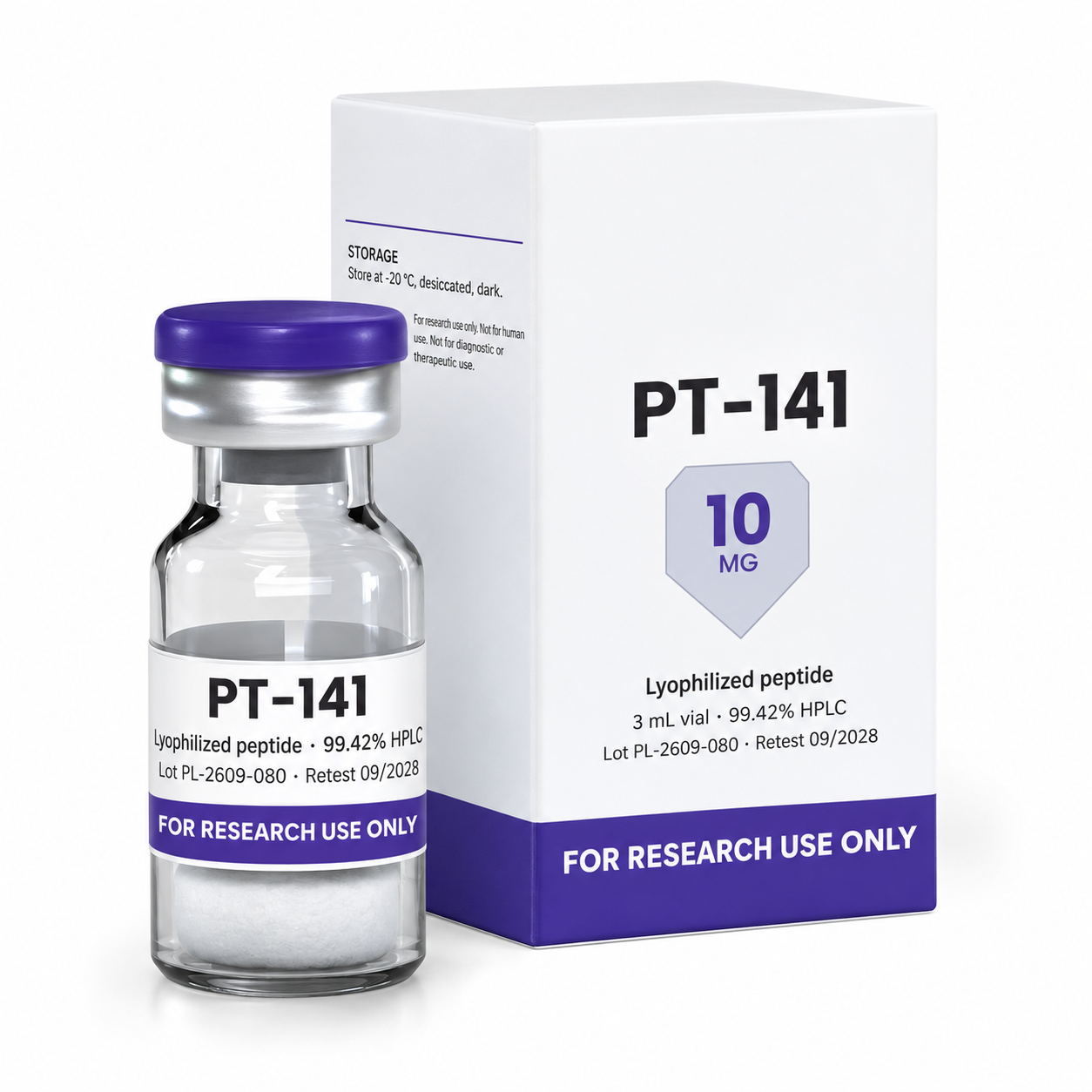 PRODUCT IMAGE
PT-141 10 mg vial
10 mg of bremelanotide powder with the matching source report for lot PL-2609-080.
- Contents
- 10 mg · 10,000 mcg
- Form
- Freeze-dried powder
- Preparation
- Mixing required
- Sealed storage
- −20°C (−4°F) · dry and dark
Powder lot PL-2609-080: 99.42% HPLC area purity. No separate mg-per-vial content assay.
 PRODUCT IMAGE
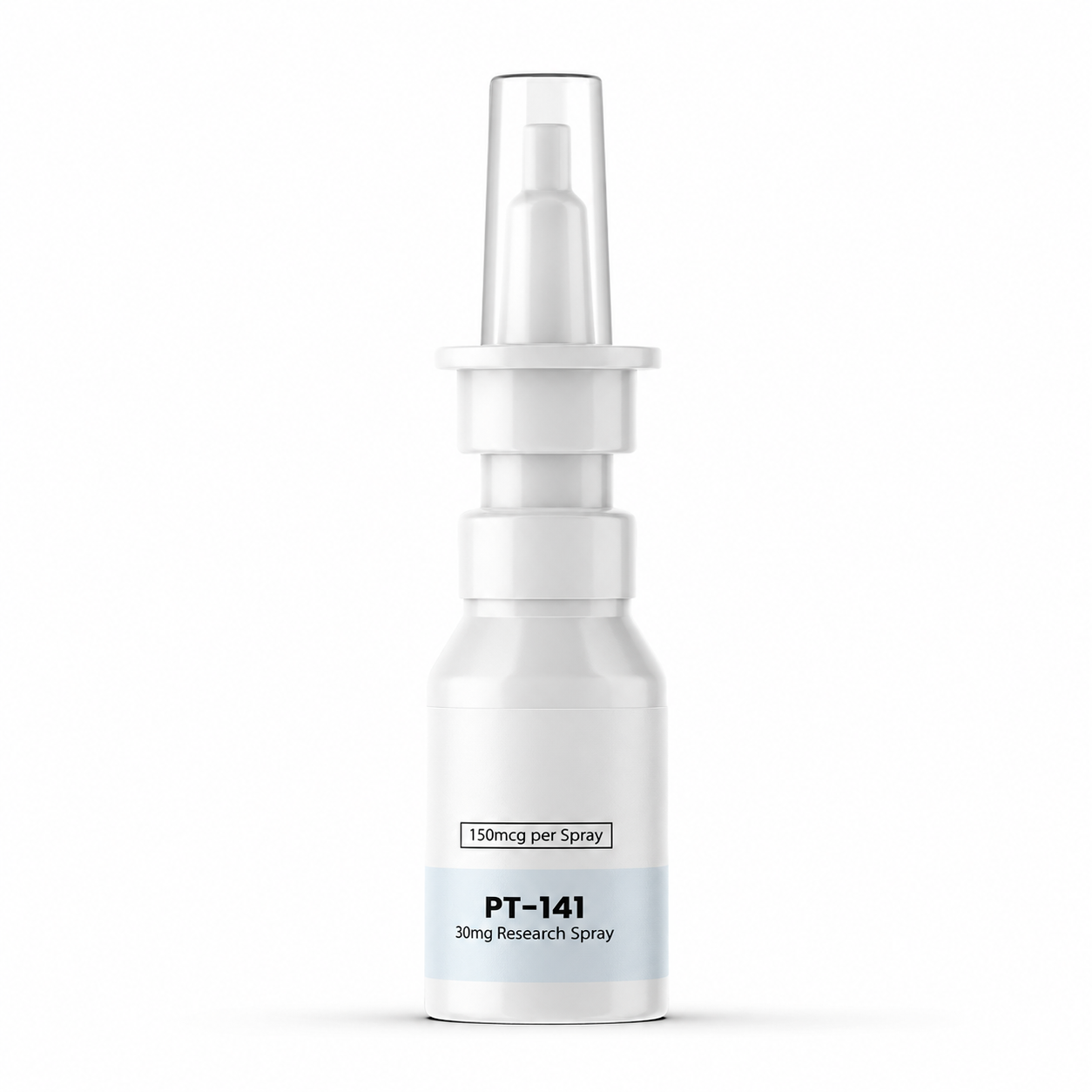
PT-141 nasal spray
Ready-made spray. The written specifications and original bottle image show different strengths and preservatives.
- Form
- Prepared nasal solution
- Per spray
- Current calibration unconfirmed
- Mixing
- No powder to dissolve
- Storage
- 2–8°C (36–46°F) · do not freeze
Written information says 10 mg with benzyl alcohol; the original images show 30 mg, 150 mcg per spray, saline and methylparaben. Current-lot strength and formulation need confirmation.
Batch COA pending.
Product photographs edited to remove supplier branding. Any unresolved specifications are identified on the product card.
The written nasal specifications describe 10 mg in water with 0.9% benzyl alcohol. The original images instead show 30 mg, 150 mcg per spray and 200 sprays, with saline and methylparaben on the side label. Those are different product descriptions. A current, batch-specific label and pump calibration are needed before calculating an amount per spray or comparing cost per milligram.
The product comparison shows the edited images and explains the discrepancy beside the spray. The vial certificate is attached to the powder product; it does not verify the finished spray's concentration, pump output or sterility.
PT-141 for men and combinations with ED medicines
Men have been included in early PT-141 research, including studies of erectile response. Investigators used controlled conditions and equipment to measure rigidity. Those findings provide evidence of a biological effect, but do not supply a reliable success percentage for men buying a vial or nasal spray online. [3]
Low desire and difficulty keeping an erection also need different assessment. PDE5 inhibitors such as sildenafil help erectile function through blood-flow mechanisms. Treatment may also need to address medication effects, low testosterone when present, or anxiety around sex. Changing a prescribed medicine or adding another drug without reviewing the cause can miss the problem that needs treatment. [8]
A small crossover study of 19 men examined intranasal PT-141 alongside sildenafil and found an enhanced measured erectile response. It was an exploratory combination study, not a validated routine stack for the supplied products. The study's nasal formulation, screening and monitoring matter, particularly because bremelanotide can raise blood pressure. [5]
The evidence is not a reason to assume that a larger amount, repeated administration on the same evening, or several sexual-function drugs together will produce a better experience. The approved frequency limit and cardiovascular restrictions still need attention; adding a drug with different blood-pressure effects does not make those effects cancel predictably.
PT-141 side effects
Nausea, flushing, injection-site reactions and headache were the most frequent adverse effects in the main injection trials. Nausea occurred in 40% of treated participants, flushing in 20.3%, injection-site reactions in 13.2% and headache in 11.3%. These are participant rates during the trials, not the probability attached to every injection. [1]
Nausea often begins within the first hour and commonly lasts around two hours. That timing can overlap the intended activity. Persistent or severe nausea is a reason to contact the prescriber about symptom management or discontinuation. The updated label reports that taking ondansetron in advance did not prevent it.
Bremelanotide can temporarily increase blood pressure and lower heart rate. Uncontrolled hypertension and known cardiovascular disease are contraindications. Darkened patches of skin or gums can also occur and may not completely disappear after stopping. The side-effects article covers symptom timing, medication interactions and when urgent assessment is needed.
Redacted PT-141 COA: lot PL-2609-080
The attached powder-lot report gives 99.42% HPLC area purity and a matching LC-MS identity result. It describes two sampled vials from a lot of 250 and includes water, endotoxin and sterility results. The redacted two-page PDF is available below. [7]
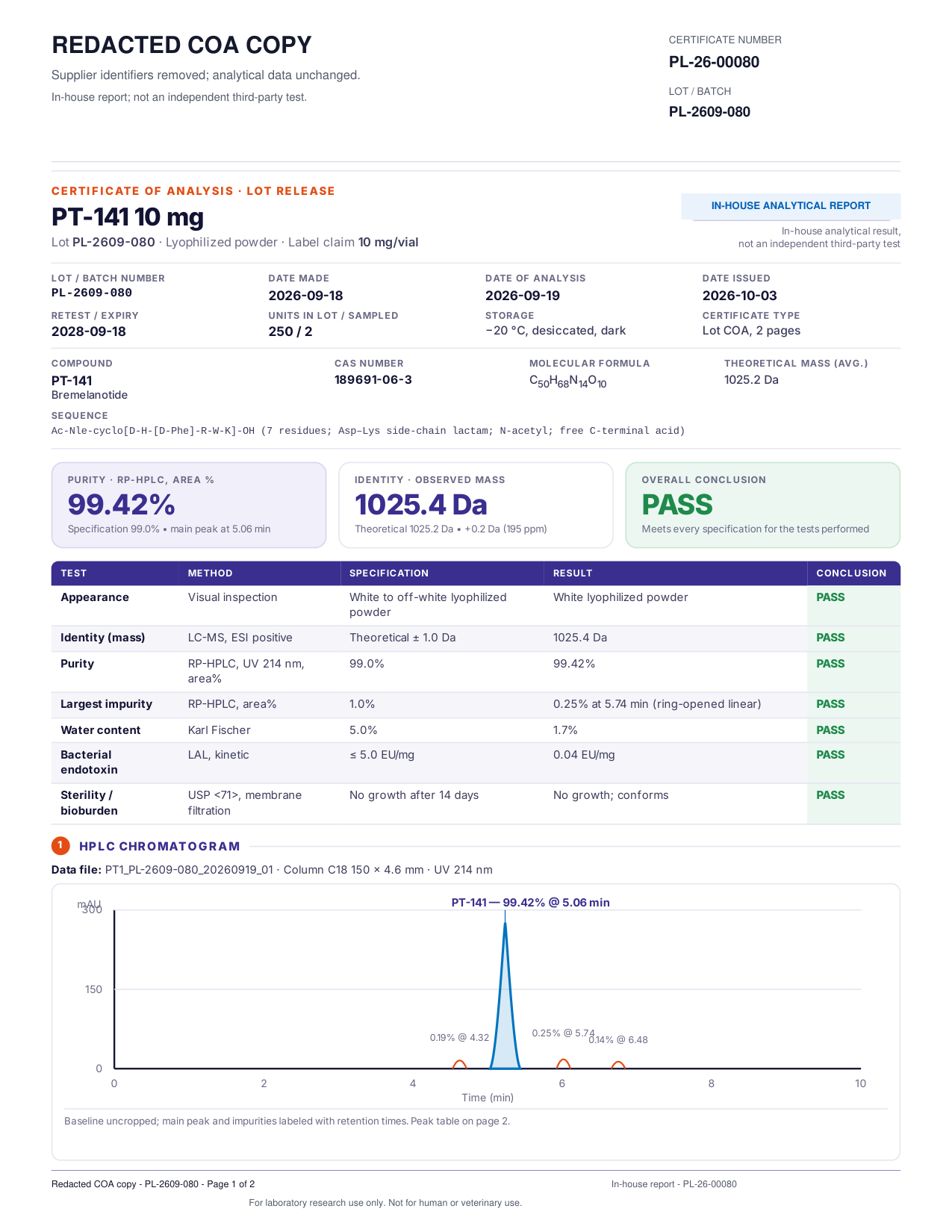
PT-141 10 mg — lot PL-2609-080
2 sampled powder vials from lot PL-2609-080; in-house testing. No separate quantitative vial-fill assay or finished-spray testing.
Open redacted COAArea purity describes the relative size of the peptide's chromatographic peak. It is not a separate measurement confirming exactly 10 mg in every vial. The certificate also does not establish an amount per spray, a safe reconstitution recipe, or the performance of a finished medicine.
Match the lot on a product to the lot on its report. The same ingredient name alone cannot extend this certificate to another batch or to a different finished format.
Questions & answers.
How much PT-141 is used in the approved injection?
Vyleesi contains 1.75 mg in a single-use autoinjector and is administered at least 45 minutes before anticipated sexual activity for eligible premenopausal women with HSDD. The limit is one administration in 24 hours and no more than eight in a month. This is the approved product's regimen.
How many units is 1.75 mg from a 10 mg vial?
With a final solution volume of 2 mL, 10 mg gives 5 mg/mL. A 1.75 mg amount occupies 0.35 mL, equal to 35 U-100 units. At a different final volume, the syringe number changes. This is arithmetic, not a validated preparation instruction.
Does PT-141 work in men?
Early studies found erectile responses in men, but Vyleesi is not approved for men and the available research does not establish a dependable male success rate or a standard schedule for the supplied research products.
Does PT-141 last for 24 or 72 hours?
A fixed duration of benefit has not been established in the approved prescribing information. The 24-hour rule is the minimum spacing between administrations, not a promise that the desired effect lasts for 24 hours.
How many sprays equal an injection?
No valid conversion can be given for this product. Its text describes 10 mg while the original images show 30 mg and 150 mcg per spray, with different excipients. Even a confirmed spray amount would not establish equivalent absorption to an injection.
Should PT-141 be used every day for eight weeks?
No. The approved regimen is as needed, within its frequency limits. Eight weeks is the point to stop treatment if symptoms have not improved; it is not a daily loading course.
Sources & batch documents8 references · expand to read
- FDA — Vyleesi prescribing information and patient information, revised October 2026 ↗
- Kingsberg et al. — two randomized 24-week RECONNECT trials in women with HSDD, 2019 ↗
- Rosen et al. — early subcutaneous PT-141 trials in healthy men and men with erectile dysfunction, 2004 ↗
- Diamond et al. — early intranasal PT-141 trials in men, 2004 ↗
- Diamond et al. — intranasal PT-141 with sildenafil in 19 men, 2005 ↗
- Product specifications — 10 mg powder vial and conflicting nasal spray documentation ↗
- Redacted PT-141 10 mg powder-lot certificate — PL-2609-080 ↗
- NIDDK — treatment for erectile dysfunction ↗