Jump to a section
GLOW = GHK-Cu + BPC-157 + TB-500
GLOW peptide combines three ingredients: the copper peptide GHK-Cu, BPC-157 and TB-500. GHK-Cu adds the skin and collagen focus to the two recovery peptides in the Wolverine Stack. GLOW is a blend name, not a fourth peptide.
The supplied vial contains 50 mg GHK-Cu + 10 mg BPC-157 + 10 mg TB-500. That is 70 mg total at a 5:1:1 ratio by weight. Its TB-500 is the full-length, 43-amino-acid thymosin beta-4 molecule. [1]
The blue colour comes from GHK-Cu. Its 50 mg label refers to the copper–peptide complex, not 50 mg of elemental copper. The vial and pen use the same ingredient ratio, but contain different totals and require different preparation. [2]
GLOW peptide benefits
Smoother fine lines
A GHK-Cu serum reduced measured wrinkle depth and volume over eight weeks. The study used a skin serum, not the injected three-peptide blend. [3]
More collagen and elastin
GHK-Cu increased both in cultured human skin cells. These proteins give skin structure and elasticity; the experiment did not measure skin tightening after GLOW injections. [3]
Less knee pain
A small knee series found pain improvement after clinical BPC-157 injections, with or without thymosin beta-4. GHK-Cu was not part of that treatment. [4]
For wrinkles, scars, loose skin and hair, the formulation matters. A cream, a wound gel and an injected blend expose different tissues to different amounts. There is no published controlled human trial establishing that this GLOW combination reproduces the topical results.
GLOW dosage and ingredient amounts
A 3.5 mg total portion contains 2.5 mg GHK-Cu, 500 mcg BPC-157 and 500 mcg TB-500. A documented GLOW account used that amount on five days per week. The same account described marked afternoon fatigue, so the number should be read with that outcome attached. [7]
17.5 mg blend per week: 12.5 mg GHK-Cu + 2.5 mg BPC-157 + 2.5 mg TB-500.
6 mg blend per week. One of several amounts in a clinic's GLOW protocol; it is a different weekly exposure. [8]
These are documented schedules, not a validated dose for everyone. 3 mg per administration and 3 mg per day are different totals. Likewise, “500 mcg” could mean 500 mcg of the whole blend or 500 mcg of BPC-157 within it.
For the 70 mg vial at a final 2 mL volume, the concentration is 35 mg/mL. A 3.5 mg target equals 0.1 mL, or 10 units on a U-100 syringe. At a final 3 mL volume, the same target equals 0.15 mL, or 15 units. These are arithmetic examples; the final volume must match the actual preparation.
Open the GLOW calculator → It shows the liquid volume and all three ingredient amounts together.
GLOW cycle length
One published clinic schedule uses 8–12 weeks. The five-days-on, two-days-off pattern above describes days within a week; it does not establish the total course length. A weekend break is also different from several weeks off between courses. [8] [7]
GLOW vial and prefilled pen
GLOW 70 mg vial
50 mg GHK-Cu + 10 mg BPC-157 + 10 mg TB-500. Fixed 5:1:1 blend.
- Form
- Blue freeze-dried powder
- Preparation
- Reconstitution required
- Sealed storage
- −20°C (−4°F) · dry · dark
- Documented lot
- PL-2609-043
Source report for the sampled powder lot.
GLOW 150 mg prefilled pen
3 mL prefilled · 50 mg/mL nominal concentration · same 5:1:1 blend.
- Ingredients
- 107 / 21.4 / 21.4 mg, rounded
- Solution
- Water + 0.9% benzyl alcohol
- Preparation
- Already mixed
- Storage
- 2–8°C (36–46°F) · do not freeze
Powder-lot COA shown for reference. It does not test the finished pen.
Research-labelled products. Drawings show the formats; they are not product photographs.
The pen contains about 2.14 times the vial's total blend amount: nominally 150 mg versus 70 mg. It is already dissolved at 50 mg/mL in a 3 mL cartridge. The vial's concentration depends on the final volume used to dissolve its powder. [2]
The pen specifications list rounded component amounts of 107 mg GHK-Cu, 21.4 mg BPC-157 and 21.4 mg TB-500. Their 149.8 mg sum reflects rounding around the nominal 150 mg label. A known concentration still does not supply a pen click size; the device calibration is needed for that conversion.
GLOW results and timelines
Wrinkle volume decreased
In a 20-person subgroup, wrinkle volume fell 24.1% on the GHK-Cu serum side and 15.0% on the comparison-serum side. This is an ingredient study, not a GLOW injection result. [3]
Facial appearance improved
One 67-year-old described a fresher facial appearance after three months. Topical GHK-Cu, Snap-8, TRT and other peptides were also used, so this account cannot isolate GLOW's contribution. [9]
Hair changes also take time to measure. A small topical GHK-Cu eyebrow study found a hair-count difference at 12 weeks, with no significant count difference at weeks four or eight. That result does not establish a scalp-hair or injectable GLOW response. [10]
GLOW before and after: changes, nonresponse and time after stopping →
GLOW, Wolverine Stack and KLOW
| Blend | Ingredients and the practical difference |
|---|---|
| Wolverine Peptide | BPC-157 + TB-500. The supplied 20 mg vial contains 10 mg of each. |
| GLOW peptide | GHK-Cu + BPC-157 + TB-500. The supplied 70 mg vial adds 50 mg GHK-Cu to the same 10 mg + 10 mg recovery pair. |
| KLOW blend | Commonly names GLOW's three ingredients plus KPV. The label must specify each amount; a blend name does not fix its ratio. |
Combining GLOW with Wolverine Stack duplicates BPC-157 and TB-500. Adding a GHK-Cu product duplicates the copper peptide. For example, 3.5 mg of this GLOW blend plus 1 mg of a 1:1 Wolverine blend totals 2.5 mg GHK-Cu + 1 mg BPC-157 + 1 mg TB-500. That is ingredient arithmetic, not an extra-stack recommendation.
Different GLOW products can also have different ratios. Copying a schedule by the word “GLOW” alone can change all three ingredient amounts. Match the actual composition before comparing quantities. [2]
GLOW side effects
Redacted GLOW COA
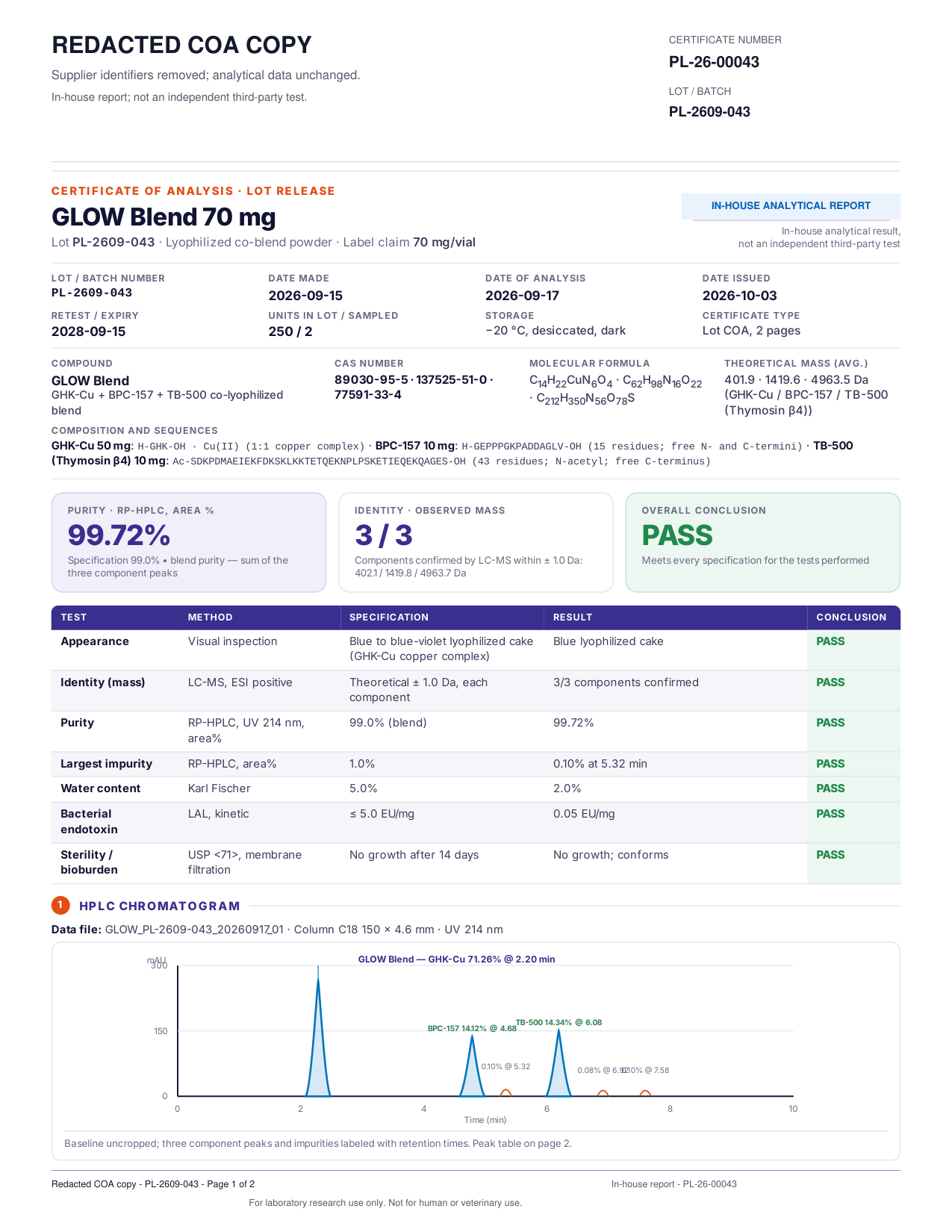
GLOW blend — powder lot PL-2609-043
Two sampled units of the named powder lot. HPLC area purity is not a fill-content assay. Shown with both formats; no finished-pen test or batch linkage is supplied.
Open redacted COA99.72% is combined HPLC area purity. The certificate identifies all three ingredients in two sampled powder vials from lot PL-2609-043. It does not independently measure each vial's milligram fill or test the finished 3 mL pen. The redacted two-page report is available beside both formats. [1]
Questions & answers.
What is in GLOW peptide?
This GLOW vial contains 50 mg GHK-Cu, 10 mg BPC-157 and 10 mg full-length thymosin beta-4 (TB-500): 70 mg total at a 5:1:1 ratio.
Is GLOW the same as Wolverine Stack?
GLOW adds GHK-Cu to BPC-157 and TB-500. Wolverine Peptide contains the recovery pair without GHK-Cu.
Does 70 mg mean 70 mg of every ingredient?
No. It is the total of all three. The individual amounts are 50 mg, 10 mg and 10 mg.
Does GLOW contain 50 mg of copper?
No. The 50 mg label refers to GHK-Cu, a complex of the GHK peptide and copper. It is not 50 mg of elemental copper.
Can GLOW replace a copper-peptide skin serum?
The products are different formulations. Human wrinkle studies used topical GHK-Cu preparations; they do not supply an equivalent injected GLOW amount or show that injections work better.
Is the pen already mixed?
Yes. The 3 mL pen has a nominal 50 mg/mL total-blend concentration. Do not add water to it. Click amounts require its device calibration.
Can GLOW help with weight loss?
GLOW is not a GLP-1 medicine. Its ingredient studies focus on skin and tissue repair; they do not establish reliable weight loss or fat reduction from the blend.
Sources & batch documents10 references · expand to read
- Redacted GLOW powder-lot COA: PL-2609-043, certificate PL-26-00043 ↗
- GLOW vial and pen specifications, checked 5 November 2026 ↗
- Badenhorst et al. (2016): topical GHK-Cu nano-carrier serum, facial wrinkle trial ↗
- Lee & Padgett (2021): BPC-157 with or without thymosin beta-4 for knee pain ↗
- Chang et al. (2011): BPC-157, tendon-cell survival and migration ↗
- Malinda et al. (1999): thymosin beta-4 and wound healing in rats ↗
- u/johnsondough: original 50/10/10 GLOW use account, ingredient amounts and fatigue ↗
- Outfit MD: published GLOW clinic schedule, 1.5 / 3 / 4.7 mg twice weekly ↗
- u/PomegranateFormal961: three-month GLOW account with concurrent topical products and other treatments ↗
- Bo et al. (2026): 2% topical GHK-Cu and eyebrow growth, split-brow study ↗