Jump to a section
Choose your Wolverine Stack product
Online ordering is not available yet.
Wolverine Stack 20 mg vial
10 mg BPC-157 + 10 mg TB-500. Fixed 1:1 blend.
- Form
- Freeze-dried powder
- Preparation
- Reconstitution required
- Sealed storage
- −20°C · dry · dark
- Documented lot
- PL-2609-011
COA for the sampled powder lot.
Wolverine Stack 3 mL prefilled pen
Both ingredients already in solution. No powder mixing.
- Form
- Prefilled liquid cartridge
- Peptide strength
- Needs confirmation
- Solution
- 0.9% benzyl alcohol
- Storage
- 2–8°C · do not freeze
Strength conflict: 20 mg combined in the title; 20 mg of each in the specifications. Confirm the current pen label before calculating an amount.
Redacted batch COASame supplied blend-lot COA. It does not test the finished pen.
Research-labelled products. Drawings show the formats; they are not product photographs.
Wolverine Stack 20 mg vial — 10 mg + 10 mg
10 mg BPC-157 and 10 mg TB-500, already blended in one freeze-dried vial. The total is 20 mg. [1]
Each portion contains half its peptide weight as BPC-157 and half as TB-500. For example, 1 mg of this blend contains 500 mcg of each ingredient. The amount on the front of the vial is its total content, not one dose.
Preparation: the dry powder needs dissolving before a liquid volume can be measured. The final volume determines the concentration. Adding more liquid spreads the same 20 mg through a larger volume; it does not change the ingredient ratio. 20 mg vial preparation and concentration examples →
Documented lot: PL-2609-011. The source report gives 99.65% combined HPLC area purity and identifies both peptides by mass spectrometry. Open the vial COA →
Wolverine Stack prefilled pen — 3 mL
BPC-157 and TB-500 already dissolved in a 3 mL cartridge. The solution contains 0.9% benzyl alcohol as a preservative. No powder mixing or added water is required. [2]
- Liquid volume
- 3 mL
- Preparation
- Already dissolved
- Delivery
- Pen-specific dial instructions required
Pen clicks: no verified volume-per-click specification is available. A syringe unit and a pen click are different measurements. The vial calculator cannot supply this pen's dial setting.
Open the blend-lot COA shown with this pen →
This is the same redacted powder-lot report provided with the vial. It does not test the finished cartridge or resolve the pen's conflicting strength specifications.
10 mg blend, 10 mg + 10 mg, and 20 mg each
The two ingredient amounts matter more than the largest number on the packaging. A 10 mg total blend and a vial containing 10 mg of each peptide have different contents, even when both are described as “10 mg Wolverine Stack”.
| Wording | BPC-157 | TB-500 | Total |
|---|---|---|---|
| 10 mg total · 1:1 | 5 mg | 5 mg | 10 mg |
| 10 mg + 10 mg · supplied vial | 10 mg | 10 mg | 20 mg |
| 20 mg of each peptide | 20 mg | 20 mg | 40 mg |
Label arithmetic. Only the middle row describes the supplied vial; the other rows explain wording, not additional products for sale. [1]
A larger total also does not guarantee more BPC-157. A 1:1 blend puts half its peptide mass into BPC-157; a different ratio changes that share. 1:1 and 2:1 ingredient splits →
The two ingredients in the blend
BPC-157 · 10 mg
A 15-amino-acid peptide. The supplied lot's measured identity mass is 1419.8 Da.
TB-500 · 10 mg
Full-length, 43-amino-acid thymosin beta-4. The supplied lot's measured identity mass is 4963.7 Da.
The TB-500 in this documented lot is the complete thymosin beta-4 chain. The certificate records its sequence as well as the measured mass. [1]
The shorter TB-500 fragment has seven amino acids and a mass of about 888.5 Da, versus roughly 4963 Da for the full-length molecule. They are different ingredients, so a matching trade name is not enough for a like-for-like comparison. [3]
A fixed blend keeps both amounts linked: increasing its total amount increases both ingredients together. A 20 mg Wolverine Stack vial therefore contains the same labelled BPC-157 amount as a 10 mg BPC-157-only vial, plus 10 mg of TB-500. Compare BPC-157-only products →
Wolverine Stack cost per milligram
For the supplied vial, divide its price by 20 to get the cost per milligram of total blend. Dividing by 10 would count only one ingredient while charging the full product price against it.
A 10 mg total blend contains half as much peptide as this 20 mg vial. At the same price and the same ingredient ratio, the 20 mg vial has half the cost per milligram. Different ratios, different TB-500 molecules and different formats require separate comparisons.
For separate products, add the cost of 10 mg BPC-157 + 10 mg TB-500 before comparing that combined amount with one Wolverine Stack vial. Include required diluent and delivery supplies when they are priced separately. The pen's cost per milligram needs its confirmed peptide strength first.
Retail prices and checkout destinations have not been supplied for these pages. No current price or availability is implied by the product cards. Total vial quantities for the worked course examples →
Storage for powder and liquid
−20°C · dry · dark
Keep the freeze-dried vial sealed, protected from moisture and light. The powder-lot retest/expiry date is 17 September 2028. [1]
2–8°C · do not freeze
Refrigerate in the original carton. Discard a pen if its solution has frozen, become cloudy or changed colour. [2]
The dry vial's expiry does not become the expiry of a prepared solution. A post-mixing use limit and an in-use pen limit need their own product instructions; neither is specified in the supplied certificate.
Redacted Wolverine Stack COA
Certificate PL-26-00011 covers powder lot PL-2609-011. It is an in-house laboratory report, analysed on 19 September 2026 and issued on 3 October 2026. Two units were sampled from a 250-unit lot. [1]
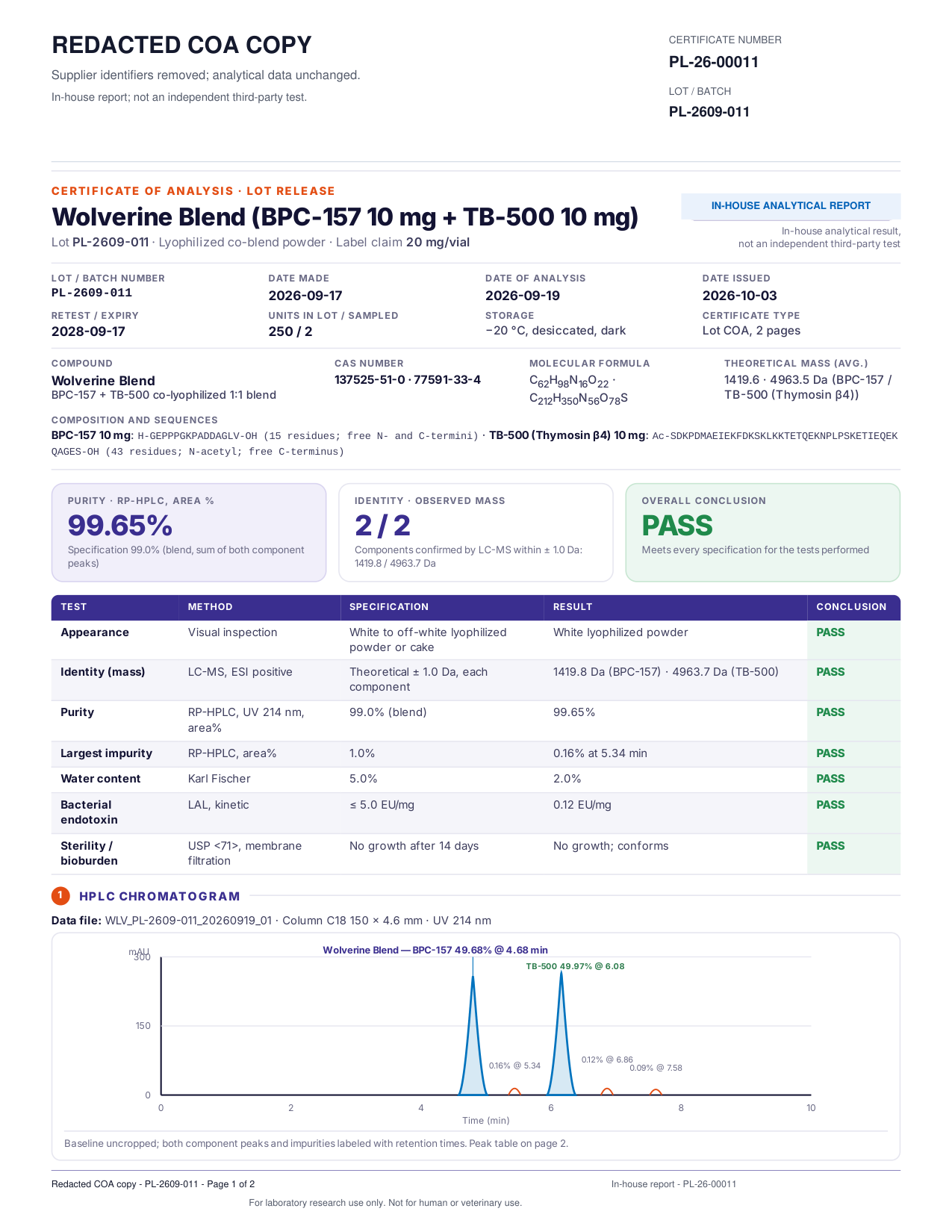
Wolverine blend — powder lot PL-2609-011
Named freeze-dried blend lot. HPLC area purity is not a separate fill-content assay. Shown with both formats; no finished-pen result is supplied.
Open redacted COA| Test | Recorded result | What the number means |
|---|---|---|
| RP-HPLC purity | 99.65% | The two peptide peaks make up 99.65% of the integrated peak area. |
| LC-MS identity | 1419.8 / 4963.7 Da | Measured masses for BPC-157 and full-length TB-500. |
| Water content | 2.0% | Water measured by Karl Fischer titration. |
| Endotoxin | 0.12 EU/mg | Result from the kinetic LAL test. |
| Sterility | No growth after 14 days | USP <71> result for the sampled powder lot. |
Purity and milligram content are separate measurements. The certificate lists 10 mg + 10 mg as the label claim; it does not include a separate fill-content assay. Its 99.65% figure comes from adding the BPC-157 peak area, 49.68%, to the TB-500 peak area, 49.97%.
The redacted two-page PDF is available from both product sections. Its testing scope remains the named powder lot. A finished-pen report would need to identify the filled cartridge and test the final solution.
99.65% purity, identity and actual content
99.65% is the combined area of two HPLC peaks. It is not a measurement of 19.93 mg in the vial, and it is not proof that the pen contains either 20 mg or 40 mg. HPLC peak area and fill-content testing answer different questions. [1]
Identity and purity
Mass spectrometry identifies BPC-157 at 1419.8 Da and full-length thymosin beta-4 at 4963.7 Da. HPLC records their peak areas at 49.68% and 49.97%.
Amount and delivery
A quantitative content assay measures milligrams per vial or cartridge. Device testing measures the volume delivered by the pen. Neither result is present in this powder-lot certificate.
Nearly equal peak areas do not independently establish an exact 1:1 mass ratio. The 10 mg + 10 mg split remains the product's labelled composition; it is not a separately reported per-vial assay.
The report's sterility and endotoxin results apply to the sampled powder lot. Filling a liquid cartridge adds manufacturing and storage steps, so the same PDF cannot verify the finished pen's concentration, shelf life or delivered amount. [1]
Package details
The vial option is one blended powder vial; the pen option is one prefilled device. Separate diluent, syringes, spare needles and other accessories are not confirmed as included. [2]
For ingredient amounts and the blend calculator, continue to Wolverine Stack dosage and vial calculations. For the difference between combination results and research on each ingredient, see Wolverine Stack benefits.
Questions & answers.
Does 20 mg mean 20 mg of each peptide?
For the vial, no. It means 10 mg BPC-157 plus 10 mg TB-500, or 20 mg total. The pen has conflicting specifications and needs a confirmed carton strength.
Does the pen need reconstitution?
No. Its peptides are already dissolved in the 3 mL cartridge. Do not add water to the pen.
Is the COA available for both formats?
Yes. Both product sections link to the supplied redacted blend-lot COA. It covers powder lot PL-2609-011; it is not a finished-cartridge test.
Is this independent third-party testing?
No. The certificate identifies the testing as in-house. It lists no attached outside-laboratory reports.
How many 1 mg portions are in the vial?
Twenty by label arithmetic: 20 mg divided by 1 mg. Each portion contains 500 mcg BPC-157 plus 500 mcg TB-500. Actual usable yield can be lower because of preparation losses and discard limits; this is not a treatment schedule.
Can the two peptides be adjusted separately?
No. They are combined at a fixed 1:1 ratio by weight in this vial. Increasing or decreasing the total blend changes both ingredient amounts together.
Is a 20 mg Wolverine Stack vial twice as much BPC-157 as a 10 mg BPC-157 vial?
No. This Wolverine Stack vial contains 10 mg BPC-157 plus 10 mg TB-500. Its BPC-157 amount is the same; the extra 10 mg is the second peptide.
Does 99.65% purity verify the amount in the pen?
No. It is the combined HPLC peak-area result for the sampled powder lot. The certificate does not measure the finished pen’s concentration or the amount delivered by its dial.