Jump to a section
What is MOTS-C?
MOTS-C is a 16-amino-acid peptide studied for glucose handling, exercise capacity and the way cells adapt to metabolic stress. Its name refers to a short coding region in mitochondrial DNA. Mitochondria help cells produce energy; MOTS-C is one of the signals through which they communicate with the rest of the cell. [1]
The main interests are better insulin sensitivity, endurance, body composition and physical function with age. The most detailed treatment findings come from laboratory and animal studies. Human research includes measurements of naturally occurring MOTS-C during exercise and a registered trial of administered MOTS-C in adults with prediabetes. These answer different questions: an exercise-related rise describes the body's response, while a treatment trial tests what an added dose does. [2] [4]
The two formats covered here are a 40 mg powder vial and a 30 mg prefilled pen containing 3 mL at 10 mg/mL. Both contain MOTS-C. The vial requires preparation to a defined concentration; the pen already contains solution. The matching vial-lot report records 99.56% HPLC area purity. [6] [7]
MOTS-C is also different from NAD+, a coenzyme involved in energy metabolism. Their shared connection to mitochondria does not give them the same dose, effect or preparation instructions. The ingredient, concentration and delivery format should stay clear throughout any comparison.
MOTS-C benefits: the main research findings
Insulin sensitivity
Muscles handled glucose more effectively in the original experiments. After seven days, the glucose infusion rate needed during an insulin clamp was about 30% higher, a measure of improved insulin sensitivity.
Endurance
Older mice ran longer and farther after two weeks of treatment. Exercise capacity is one of the clearest functional findings in the early research.
Body composition
MOTS-C limited high-fat-diet-related weight and fat gain in mice. This supports research into metabolic health; it does not supply a human pounds-lost forecast.
Muscle preservation
A study of immobilized mouse muscle found less wasting over eight days. Preserving muscle during disuse is a different outcome from adding muscle in a healthy lifter.
Stress adaptation
MOTS-C participates in signals that adjust fuel use and gene activity under metabolic stress. This helps explain why it is investigated alongside exercise and aging.
Physical function with age
Late-life experiments examined grip, walking and gait. These are measures of function and healthspan, distinct from proving longer human life.
The benefits guide gives the study designs, measured changes and practical meaning of each result. [1] [2] [3]
For a reader interested in training, the useful distinction is between endurance, strength and recovery. A longer treadmill run measures one aspect of performance. It does not establish the same improvement in maximum lifting strength, delayed-onset soreness or time needed between sessions. Each outcome needs its own assessment.
MOTS-C results and timelines
The clearest published numerical results describe specific experiments, with different time frames for glucose handling, exercise and muscle preservation. Keeping the population beside the number makes the result easier to interpret.
| Setting | Measured change | Time frame |
|---|---|---|
| Insulin-resistant mice | About 30% higher glucose infusion rate during an insulin clamp | Seven days of treatment |
| Older mice, 22 months old | About 2× running time and 2.16× running distance versus controls | Two weeks |
| Immobilized mouse muscle | About 5% muscle loss with MOTS-C versus about 15% in controls | Eight days |
| Ten men performing cycling exercise | Circulating natural MOTS-C rose about 1.6× during exercise and returned to baseline after recovery | Exercise and four-hour follow-up |
| Adults with prediabetes: MOTS-MET | Registered trial assessing insulin sensitivity and other metabolic outcomes | 12 treatment weeks; results not posted |
The human exercise study measured the body's own peptide; participants did not receive MOTS-C injections. Animal treatment results are presented in their original setting. [1] [2] [3] [4]
For body-composition comparisons, useful measurements include body weight, waist circumference and the same assessment method at each visit. For endurance, repeat the same distance, speed or workload under comparable conditions. A change in diet, training volume, sleep or another treatment can contribute to the result. These are ways to make a record interpretable, rather than a predicted response to MOTS-C.
The before-and-after guide follows the actual study timelines and explains what the measured changes mean for fat loss, muscle and performance expectations.
How does MOTS-C work?
MOTS-C influences how cells respond when energy supply and demand change. In the discovery experiments, it affected folate and purine metabolism, increased a metabolic intermediate called AICAR and activated AMPK. AMPK helps coordinate fuel use when cells need to conserve or produce energy. Skeletal muscle was a major target of these effects. [1]
The practical idea is improved handling of available fuel, particularly glucose in muscle. That mechanism provides a reason to study insulin sensitivity and exercise capacity. It does not mean that each milligram delivers a fixed amount of extra energy or that the peptide works like a stimulant.
Cell experiments also describe communication between mitochondria and the nucleus during stress. Changes in gene activity can help a cell adapt to a demanding environment. Mechanism studies are useful for choosing clinical questions, but a change in a signalling pathway is not itself a measured improvement in fatigue, weight or athletic performance. [2]
CB4211 sometimes appears in searches for MOTS-C human trials. It is a modified analogue developed from this research, with its own formulation and clinical programme. Its study doses and outcomes should remain attached to that compound. [5]
MOTS-C dosage: daily frequency and measured amounts
The registered MOTS-MET study uses a fixed subcutaneous dose once daily for 12 weeks. The public record does not state the milligram amount. As of 7 November 2026, it is listed as recruiting, with an estimated 120 participants and no results posted. [4]
The schedule being studied in adults with prediabetes, followed by four weeks of safety follow-up.
At 20 mg/mL, 5 mg occupies 0.25 mL. This is a concentration calculation, not the study's undisclosed dose.
A product's total content answers how much material is in the package. It does not identify a daily amount. The dosage and cycles guide keeps the study schedule, preparation steps and milligram-to-volume calculations together so that the figures can be used correctly.
Animal papers often express treatment in milligrams per kilogram and use intraperitoneal administration. Those experimental regimens cannot be copied into a human subcutaneous schedule simply by multiplying by body weight. The useful numbers for preparing a concentration are the labelled vial mass and the final solution volume.
40 mg MOTS-C vial: reconstitution calculations
A 40 mg vial prepared to a final volume of 2 mL gives 20 mg/mL. A 5 mg portion then occupies 0.25 mL, equal to 25 units on a U-100 volume scale.
The vial is a 3 mL container holding dry powder. Its capacity and the final prepared volume are separate measurements. For example, a final volume of 1 mL produces 40 mg/mL; the same 5 mg portion then occupies 0.125 mL, or 12.5 U-100 units. The concentration changes because the same peptide mass is distributed through a different volume. [6]
The interactive MOTS-C calculator accepts the vial mass, final solution volume and target amount in mg or mcg. It returns concentration, liquid volume, U-100 units and mathematical portions. Its opening example is 40 mg, 2 mL and 5 mg.
For preparation, use a compatible diluent and the method specified for the intended formulation. Record the concentration and preparation date. U-100 units describe liquid volume: 100 units equals 1 mL. They do not measure peptide potency or identify a pen setting.
MOTS-C cycles and weekly frequency
Once-daily administration means seven administrations per week; 12 weeks contains 84 scheduled treatment days. Those figures describe the registered trial schedule. Its subsequent four-week observation period is a follow-up interval, rather than proof of a required break before repeating treatment. [4]
Some animal experiments used daily treatment over one or two weeks; a late-life mouse experiment used an intermittent schedule. Those schedules explain the research behind cycle discussions. They do not establish a universal human course, repeat interval or maintenance frequency. [2]
To calculate material for an independently specified plan, multiply the amount per administration by administrations per week and the number of weeks. Keep that inventory calculation separate from choosing the regimen. A 40 mg vial contains eight mathematical 5 mg portions; the 30 mg pen contains six, before losses. The dosage guide places full product-quantity calculations after frequency, preparation and format comparisons.
Buy MOTS-C: 40 mg vial or 30 mg pen
 PRODUCT IMAGE
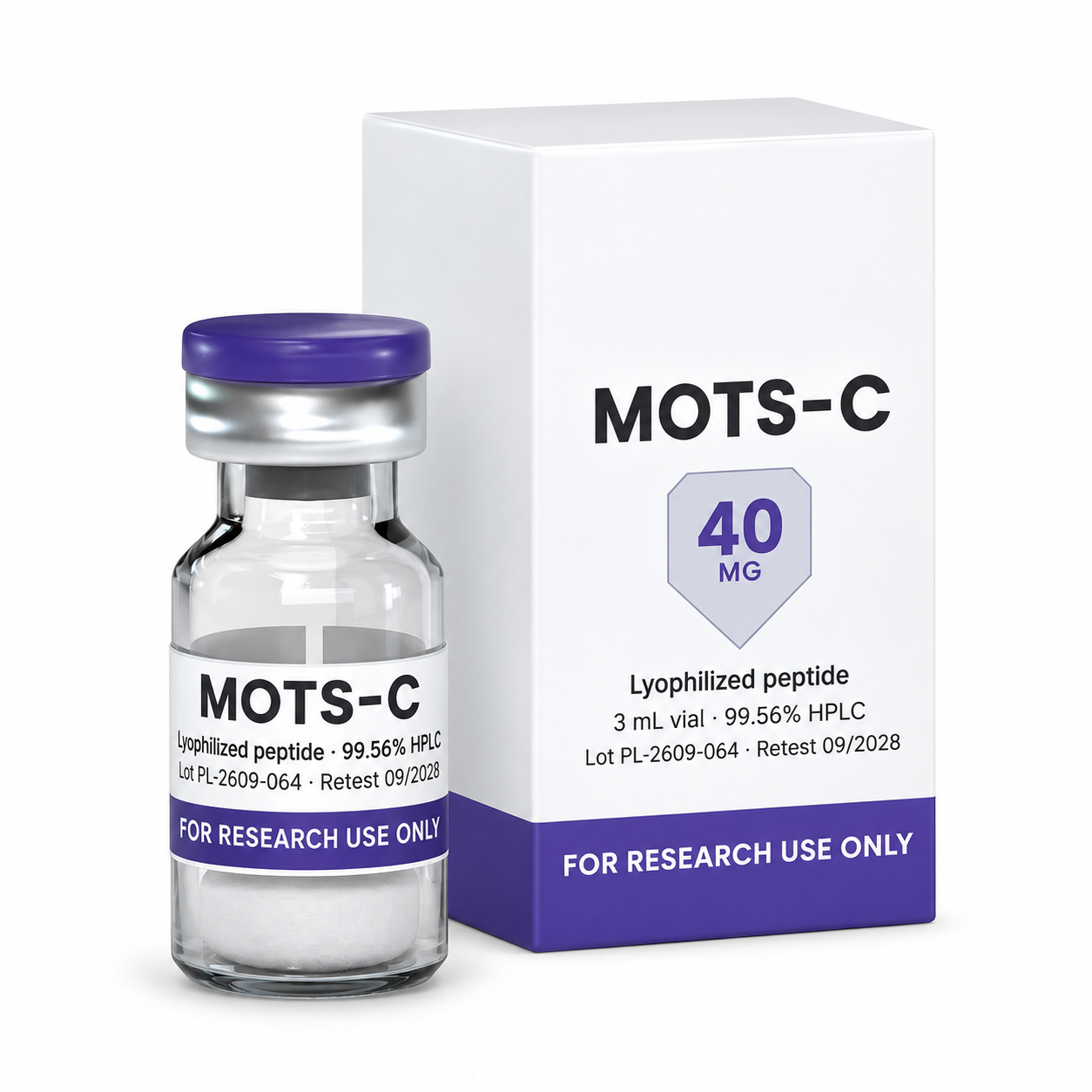
MOTS-C 40 mg vial
Freeze-dried MOTS-C with the matching report for lot PL-2609-064. Reconstitution sets the working concentration.
- Contents
- 40 mg · dry powder
- Container
- 3 mL vial
- Preparation
- Reconstitution required
- Storage
- −20°C (−4°F) · dry and dark
Powder lot PL-2609-064: 99.56% HPLC area purity. The report does not include a quantitative mg-per-vial content assay.
 PRODUCT IMAGE
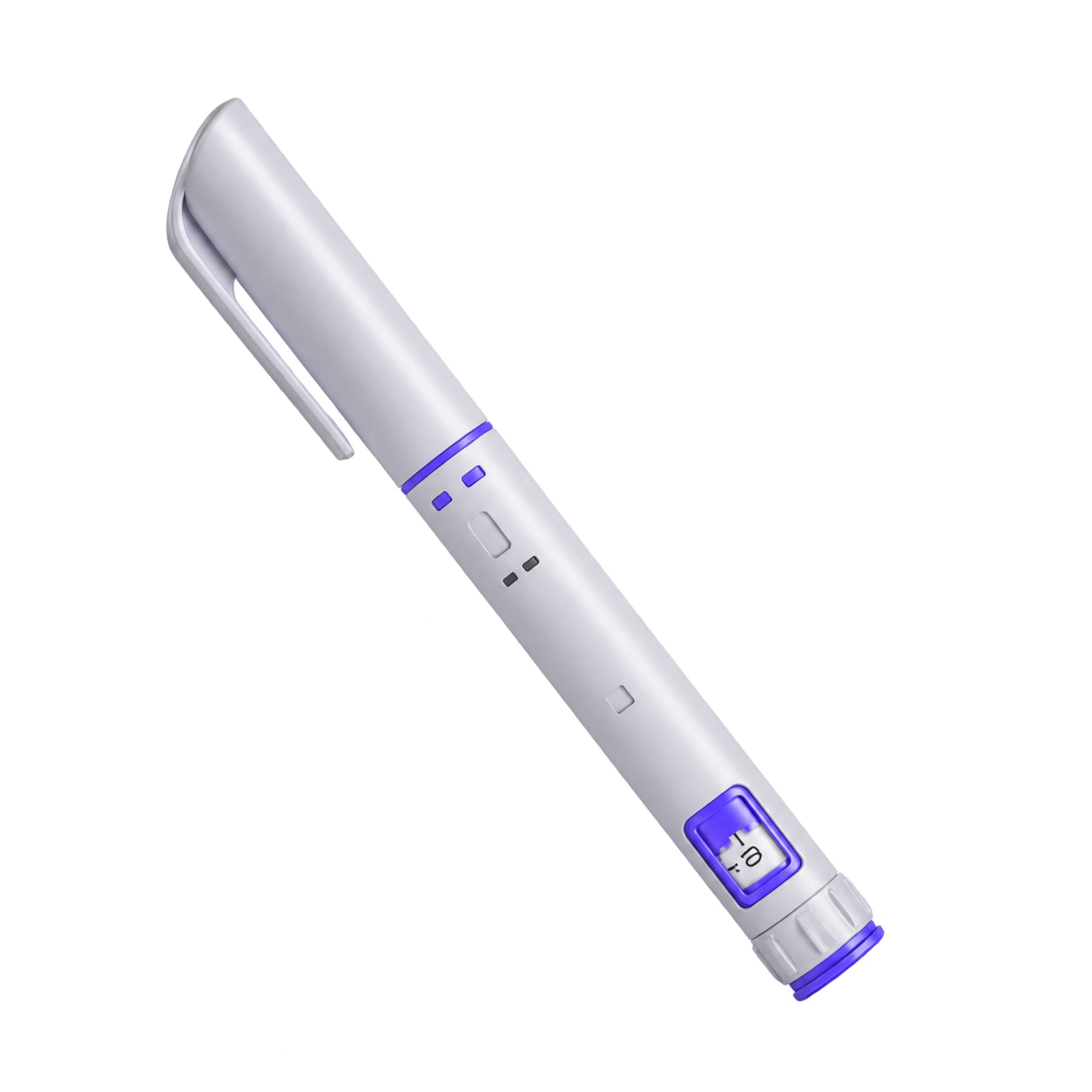
MOTS-C 30 mg prefilled pen
3 mL of prepared MOTS-C solution at 10 mg/mL, with no powder-mixing step.
- Cartridge
- 3 mL · 10 mg/mL
- Solution
- Water + 0.9% benzyl alcohol
- Preparation
- Already mixed
- Storage
- 2–8°C (36–46°F) · do not freeze
Batch COA pending.
Product photographs edited to remove supplier branding.
The 40 mg vial contains one-third more total MOTS-C than the 30 mg pen. That is a comparison of labelled mass. The formats differ mainly in preparation, concentration and handling. [6]
The vial is freeze-dried powder. Its working concentration follows the final volume used during preparation. The pen contains 3 mL of solution at 10 mg/mL and requires no reconstitution. At that concentration, 1 mg occupies 0.1 mL, 2.5 mg occupies 0.25 mL and 5 mg occupies 0.5 mL.
Compare those pen figures with the 20 mg/mL vial example: 5 mg occupies 0.25 mL in the prepared vial and 0.5 mL in the pen's solution. The peptide mass is the same while the liquid volume doubles. This is why volume and milligrams should appear together when checking an amount.
The buying guide includes both product formats, unbranded photographs, storage instructions and the downloadable vial-lot report.
MOTS-C storage before and after preparation
Store sealed powder at −20°C, dry and protected from light. Keep the vial closed while it comes to room temperature before opening, to limit condensation. The supplied lot's retest date is 5 September 2028 under its stated storage conditions. [7] [6]
Prepared vial solution is refrigerated at 2–8°C and protected from light. Record the preparation-specific discard date; the sealed powder's retest date does not set the usable life of a mixed solution. [6]
Keep the prefilled pen at 2–8°C in its carton, capped between uses. Do not freeze it. Its solution contains 0.9% benzyl alcohol. The product handling information calls for discarding a pen that has frozen or becomes cloudy or discoloured. Refrigeration preserves the intended storage conditions; it cannot reverse contamination or damage. [6]
MOTS-C side effects and practical precautions
A reliable human side-effect rate for administered native MOTS-C has not yet been established. The FDA identifies concerns about immune reactions, peptide impurities and adequate characterization of compounded MOTS-C. These concerns are distinct from the normal presence of a related peptide signal in the body. [8]
Injection-site discomfort, swelling or redness needs to be interpreted alongside preparation, technique and the formulation. Spreading redness, increasing warmth, drainage or fever warrants medical assessment. Breathing difficulty, fainting or facial or throat swelling calls for emergency help. These are general reaction and infection signs, rather than measured MOTS-C trial frequencies. [9] [10]
The side-effects guide explains the available safety evidence, symptoms that matter and the relevance of glucose-lowering medicines. MOTS-MET excludes people taking such medicines, as well as pregnant or breastfeeding participants and certain significant medical conditions; its eventual results will need to be interpreted within that study population. [4]
MOTS-C 40 mg batch report
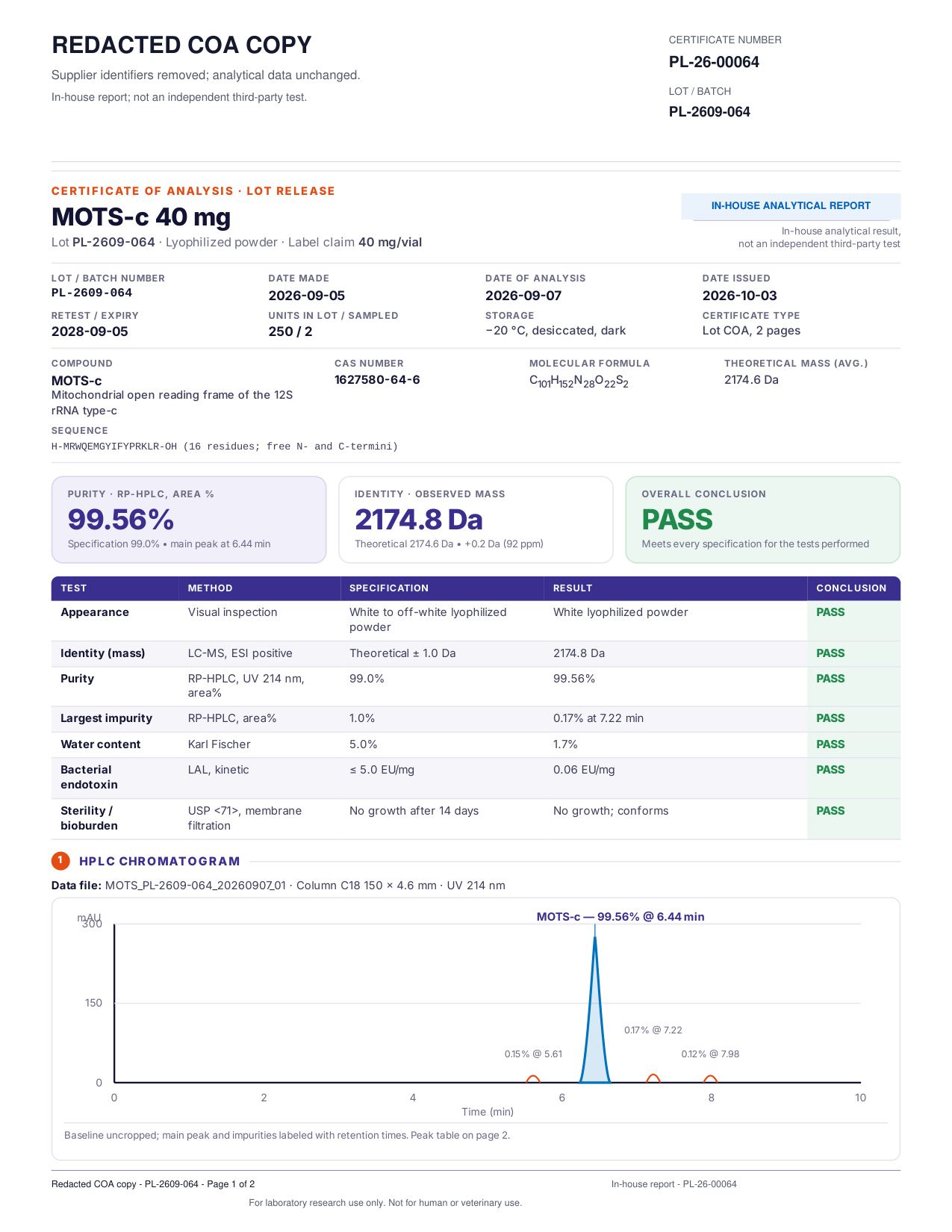
MOTS-C 40 mg — lot PL-2609-064
2 sampled powder vials from lot PL-2609-064; in-house testing. No separate quantitative vial-fill assay or finished-pen test.
Open redacted COAThe supplied certificate covers 40 mg powder lot PL-2609-064 and reports 99.56% HPLC area purity. It records an observed mass of 2174.8 Da against a theoretical 2174.6 Da, water content of 1.7%, endotoxin of 0.06 EU/mg and no growth after the stated 14-day sterility test. Two units were sampled from a 250-unit lot. [7]
Purity, identity and fill amount answer different questions. HPLC area purity compares the main peak with the integrated chromatographic area. Mass spectrometry supports identity. The report lists a 40 mg label amount, but does not contain a separate quantitative assay of the peptide mass in each vial. Multiplying 40 mg by 99.56% would therefore not produce a verified fill result.
The public PDF is marked as a redacted in-house report. Supplier identifiers have been removed while analytical results, methods, dates and lot details are retained. Its testing scope is the sampled powder lot; the prefilled pen is a separate finished formulation. The buying article explains the report and links to both pages.
Questions & answers.
What is MOTS-C used for in research?
MOTS-C is studied for insulin sensitivity, exercise capacity, metabolic stress responses and muscle function with age. The strongest treatment findings are from cell and animal experiments. A registered human trial is investigating metabolic outcomes in adults with prediabetes.
How much MOTS-C is in the vial and pen?
The vial contains 40 mg of dry powder. The pen contains 30 mg in 3 mL at 10 mg/mL. The vial has one-third more total labelled peptide; the pen arrives as prepared solution.
How many units is 5 mg from a 40 mg vial?
At a final solution volume of 2 mL, the concentration is 20 mg/mL. A 5 mg portion occupies 0.25 mL, or 25 U-100 units. This is a worked conversion, not a recommended dose. A different final volume changes the number of units.
Does MOTS-C cause weight loss?
Mouse studies found less high-fat-diet-related weight and fat gain. They do not establish a predictable number of pounds lost in humans. The current human metabolic trial has no results posted in the record reviewed on 7 November 2026.
How long is the human trial schedule?
MOTS-MET specifies a fixed subcutaneous dose once daily for 12 weeks, followed by four weeks of safety follow-up. Its public registry entry does not disclose the milligram amount.
Is MOTS-C the same as CB4211?
CB4211 is a modified analogue developed from MOTS-C research. It has its own clinical formulation and studies. Its dose and results should not be presented as findings for the native MOTS-C products shown here.
Does the pen need reconstitution?
No. It contains prepared solution at 10 mg/mL. Keep it refrigerated at 2–8°C, protected from light and capped between uses. Do not freeze it.
What does 99.56% purity mean?
It is the main MOTS-C peak as a percentage of integrated HPLC area for the tested powder lot. The certificate also reports identity, water, endotoxin and sterility results. It does not contain a separate quantitative vial-fill assay.
Sources & batch documents10 references · expand to read
- Lee et al., 2015: discovery of MOTS-c, muscle insulin sensitivity and metabolic regulation in cell and mouse experiments ↗
- Reynolds et al., 2021: exercise-induced endogenous MOTS-c in humans and physical-capacity experiments in mice ↗
- Kumagai et al., 2024: MOTS-c and immobilization-induced muscle atrophy in mice ↗
- ClinicalTrials.gov NCT07505745: MOTS-MET registered study in adults with prediabetes; status reviewed 7 November 2026 ↗
- Sponsor clinical report filed with the SEC, 2021: phase 1b results for the distinct MOTS-c analogue CB4211 ↗
- MOTS-C product specifications: 40 mg powder vial and 30 mg prefilled pen at 10 mg/mL ↗
- MOTS-C 40 mg powder lot PL-2609-064: redacted in-house certificate with original analytical results ↗
- FDA: MOTs-C safety concerns involving immune reactions, peptide-related impurities and characterization ↗
- NHS: cellulitis symptoms and urgent assessment of painful, hot, swollen skin. ↗
- MedlinePlus: anaphylaxis symptoms and emergency treatment. ↗