Jump to a section
What is BPC-157?
BPC-157 is a synthetic peptide made from 15 amino acids. Research focuses on joint pain, tendon and ligament healing, muscle recovery, wound closure and protection of the gut lining. [1]
BPC stands for Body Protection Compound. The name comes from research on a protein fragment associated with gastric juice. The BPC-157 used in products is manufactured by peptide synthesis; it is not an extract of stomach tissue or a food ingredient. [1]
Human findings: small clinical studies. Tissue-repair findings: mainly animal and cell research.
How BPC-157 works
BPC-157 changes signals involved in tissue repair. In laboratory tendon samples, repair cells moved out of the tendon more readily and survived better under stress. The experiment linked this activity to FAK and paxillin, proteins that help cells attach and move. [10]
Another experiment found more growth-hormone receptors in rat tendon cells, making those cells more responsive to added growth hormone. That does not make BPC-157 HGH or show that it raises blood HGH levels in humans. It is also a different compound from GLP-1 medicines used for appetite and weight management. [11]
BPC-157 benefits
Less knee pain
Pain improved in 11 of 12 BPC-only patients after injections into the knee joint. [1]
Easier movement
Full elbow mobility by week 6, alongside an estimated 95% reduction in pain. [3]
Shorter soreness
Post-exercise shoulder aching shortened from 48 to 24 hours by week 2. Mobility work continued. [2]
Tissue repair
Stronger healing ligaments, improved muscle function and faster wound closure in animal experiments. [1]
BPC-157 daily dosage
250 mcg once daily totals 250 mcg a day. 250 mcg twice daily totals 500 mcg a day.
250 mcg × once daily
- 7 days
- 1.75 mg
- 6 weeks
- 10.5 mg
250 mcg × twice daily
- 7 days
- 3.5 mg
- 6 weeks
- 21 mg
Public-use examples; both courses lasted six weeks. Not a prescribed regimen. [2] [3]
A 10 mg vial contains 40 daily portions at 250 mcg, or 20 at 500 mcg. Six weeks at 500 mcg/day totals 21 mg: three whole 10 mg vials or two 15 mg pens, rounded up. These calculations exclude handling losses.
BPC-157 cycle length
Six weeks, or 42 days, was the course length in both sourced examples. [2] [3]
7 mg at 250 mcg/day
14 mg at 500 mcg/day
10.5 mg at 250 mcg/day
21 mg at 500 mcg/day
14 mg at 250 mcg/day
28 mg at 500 mcg/day
Four and eight weeks are quantity comparisons, not established treatment durations.
Vial, pen, capsules or spray: compare the actual products
10 mg powder vial · 15 mg prefilled pen · 500 mcg capsules · nasal spray. Capsule bottles contain 60 units; the spray’s reference specification is 150 mcg per actuation. [6]
BPC-157 prefilled 15 mg pen
3 mL · 5 mg/mL
Prefilled liquid
View penBPC-157 500 mcg capsules
60 capsules · 30 mg
Fixed amount per capsule
View capsulesBPC-157 30 mg nasal spray
30 mg / bottle
Premixed metered format
View sprayQuantities shown for the four research-labelled products. Spray figures follow the reference specification; confirm the current bottle label. Drawings illustrate the formats; they are not product photographs.
How much is in each package?
The pen contains 50% more labeled BPC-157 than the 10 mg vial. Each 30 mg bottle contains twice the pen’s total and three times the vial’s total. Total content does not measure absorption or effectiveness.
Mix before measuring
−20°CSealed powder storage.
Prefilled liquid
2–8°CRefrigerate. Do not freeze.
No mixing
20–25°CKeep tightly closed and dry.
Premixed pump
2–8°CRefrigerate. Do not freeze.
Storage specifications for these products. Prepared-vial storage is different from sealed-powder storage. [6]
Oral BPC-157 versus injections
A 500 mcg capsule and a 500 mcg injection are not established equivalent doses. The number gives the amount in the product; it does not tell you how much reaches the bloodstream or injured tissue. Human absorption data do not supply a reliable oral-to-injection conversion. [12]
Capsules and pills
Swallowed BPC-157 is an oral format. The registered PCO-02 study planned to measure safety and absorption using tablets in healthy adults. That protocol is not a result showing that a retail capsule repairs an injury. [13]
Injections
The small human knee study used injections directly into the joint. A subcutaneous injection goes into fatty tissue under the skin; it is a different route, not the same procedure performed at home. [1]
Convenience is easier to compare than effectiveness: capsules avoid needles, a prefilled pen avoids powder mixing, and a vial requires preparation. Those differences do not establish a clinical winner.
Oral-use results → · Gut-health findings → · Capsule strength and arginate labels →
BPC-157 results and timeline
Less shoulder pain
Shorter soreness
Reduced knee pain
11 of 12Improved after BPC-157 injections into the knee joint.
[1]Shoulder figures: one six-week course with ongoing mobility work. Knee finding: an uncontrolled clinical series. These examples are not an average recovery timetable.
BPC-157 vs Wolverine: what changes in the blend?
Wolverine combines BPC-157 with TB-500. In a 1:1 blend, half the total is BPC-157 and half is TB-500.
For example, 10 mg BPC-157 + 10 mg TB-500 makes 20 mg total blend. A 500 mcg portion of that 1:1 blend contains 250 mcg of each ingredient. It does not contain 500 mcg of BPC-157. Also check whether a separate GLOW or KLOW product already includes BPC-157 before adding its amount to a stack.
BPC-157 side effects
Batch reports: the 10 mg vial and 500 mcg capsules
The attached vial certificate reports 99.74% HPLC area purity for lot PL-2609-010. The capsule certificate reports 99.62% for lot PL-2609-012 and a content assay of 494.7 mcg per capsule. Both are in-house reports for the named sampled lots. [4] [5]
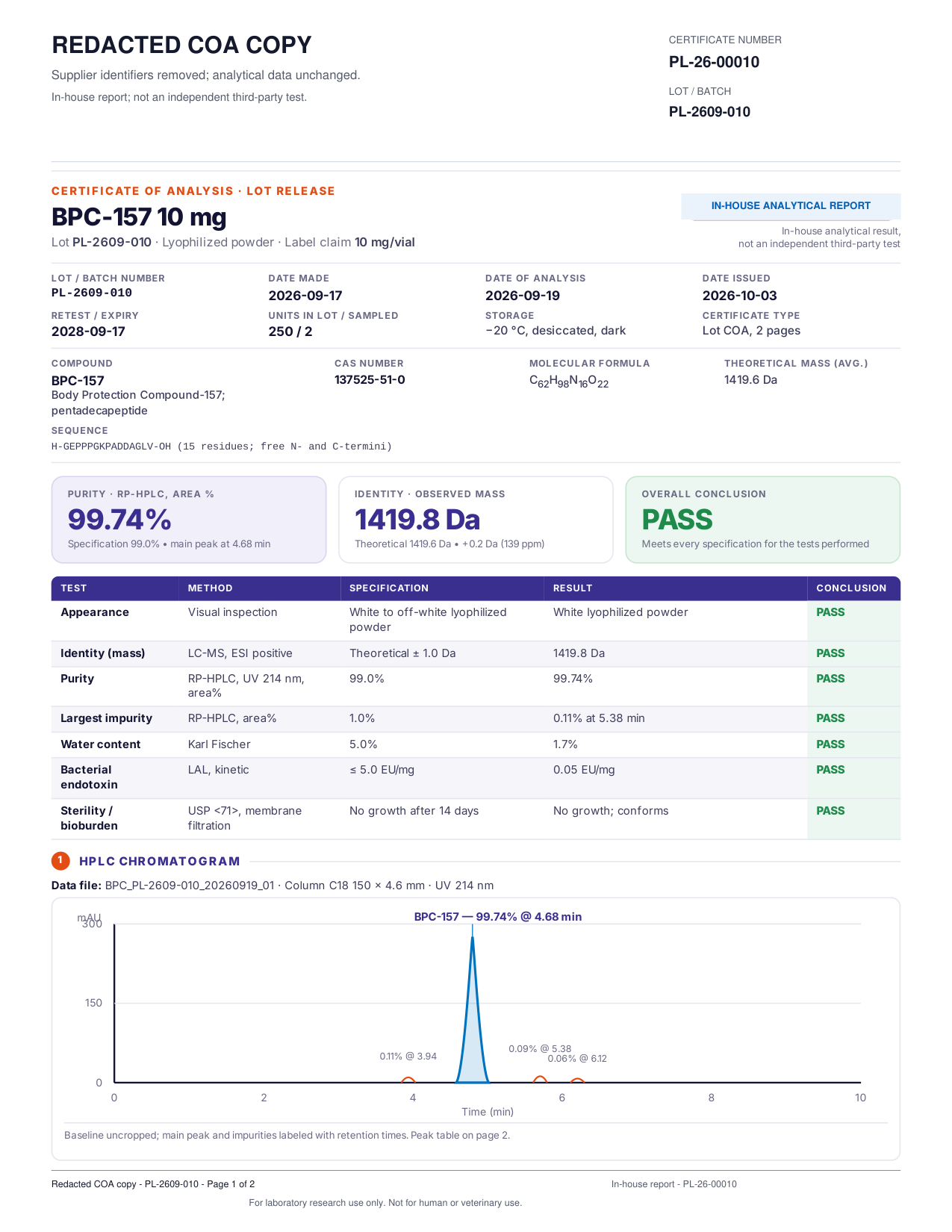
BPC-157 10 mg vial — lot PL-2609-010
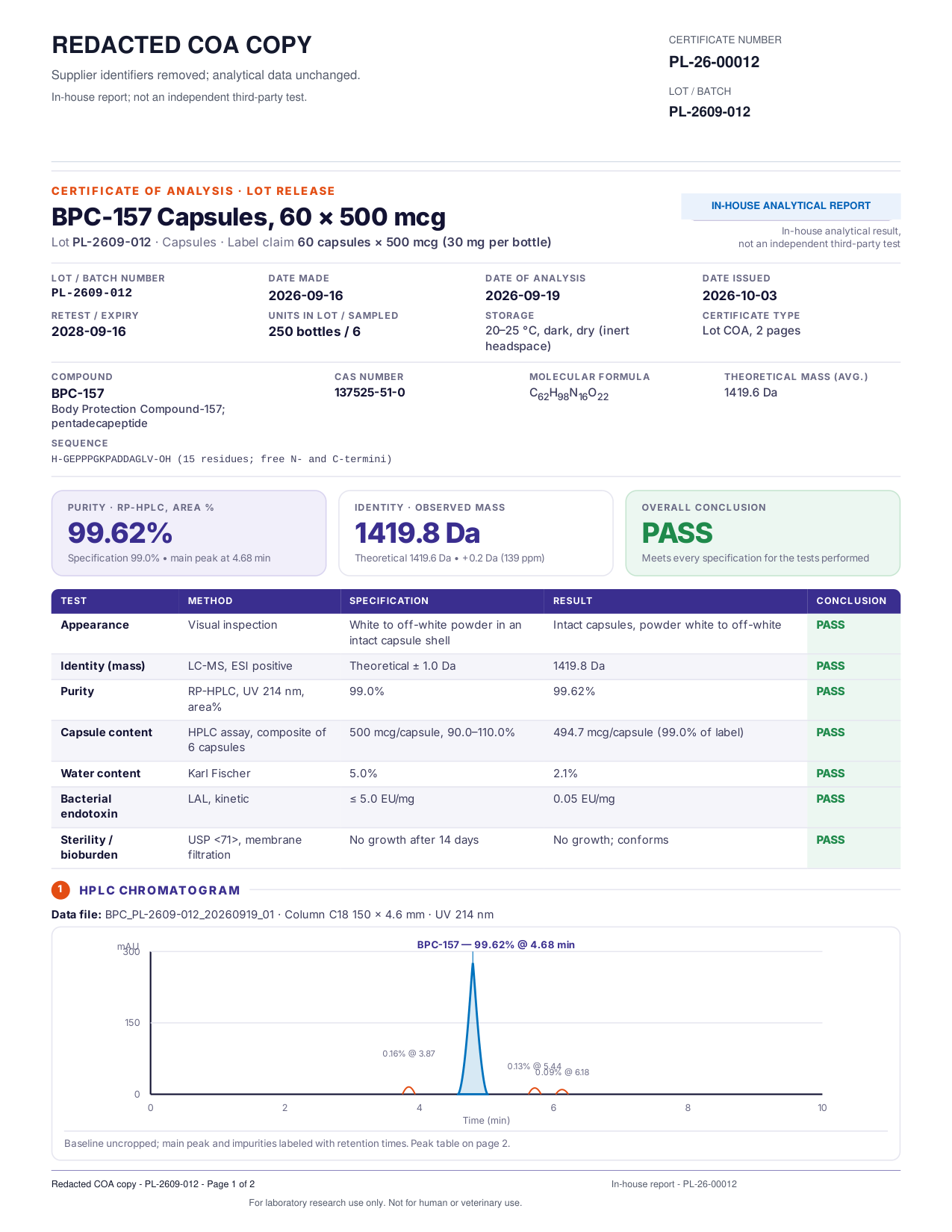
BPC-157 capsules — lot PL-2609-012
Purity measures the main compound’s share of the HPLC signal; content measures the amount per capsule. The vial report has no fill-content assay. These two reports cover the named vial and capsule lots, not the pen or spray.
Questions & answers.
What is the difference between 250 mcg once daily and twice daily?
Once daily totals 250 mcg in a day; twice daily totals 500 mcg. Over seven days those are 1.75 mg and 3.5 mg. These are reported-use examples, not a recommendation to choose one.
How many milligrams are in the BPC-157 pen?
15 mg total: 3 mL of liquid at 5 mg/mL. The total contents do not reveal the amount delivered by one click or device setting.
Is the 500 mcg capsule bottle 30 mg in total?
Yes. 60 capsules × 500 mcg equals 30,000 mcg, or 30 mg. Labeled capsule content and the amount absorbed are different questions.
How many spray amounts are in a 30 mg bottle?
At 150 mcg per spray, 30,000 ÷ 150 equals 200 nominal spray amounts. Priming, residual liquid and actual device delivery can reduce usable actuations.
Is Wolverine the same as BPC-157?
Wolverine usually means BPC-157 plus TB-500. In a 1:1 blend, half the total is BPC-157 and half is TB-500. Read the ingredient amounts, not only the blend total.
How long does a 10 mg vial last in these examples?
40 daily portions at 250 mcg, or 20 at 500 mcg. These are nominal quantity calculations before preparation and handling losses.
Sources & batch documents13 references · expand to read
- FDA scientific review of BPC-157: human findings, mechanisms and safety data (2026) ↗
- Original public six-week shoulder account, including rehabilitation and follow-up ↗
- Original elbow and cycle discussion, AnabolicMinds, February 12, 2024 ↗
- Redacted 10 mg vial certificate: lot PL-2609-010, supplied PDF ↗
- Redacted capsule certificate: lot PL-2609-012, supplied PDF ↗
- Four-product specifications, label provenance and redacted batch documents ↗
- Firsthand dizziness and nausea account, with TB-500 exposure; headache report in replies (personal accounts) ↗
- Two-month oral BPC-157 account: fatigue and uncertain muscle soreness (personal report) ↗
- Oral BPC-157 emotional-numbing account: symptoms and timing (personal report) ↗
- Chang et al. (2011): tendon-cell movement, survival and FAK–paxillin signalling ↗
- Chang et al. (2014): growth-hormone receptors in cultured rat tendon cells ↗
- FDA July 2026 scientific presentation: route-specific pharmacokinetic data, slide 44 ↗
- ClinicalTrials.gov NCT02637284: planned oral PCO-02 safety and pharmacokinetic study ↗