Jump to a section
What is NAD+?
NAD+ helps cells turn food into usable energy and supports the enzymes involved in normal cell maintenance. Its full name is nicotinamide adenine dinucleotide. The plus sign identifies its oxidized form; NADH is the related reduced form. Although often grouped with research peptides, NAD+ is a coenzyme rather than a peptide. [1]
Energy, mental clarity, workout recovery and healthy aging are the main reasons it attracts attention. Those interests come from what NAD+ does inside cells. Whether taking a particular NAD+ product produces a noticeable benefit depends on the route, formulation and outcome being measured. A change in a blood test does not automatically establish more energy or better concentration.
The range includes a 1,000 mg powder vial, a 1,500 mg prefilled pen with 3 mL at 500 mg/mL, and a 30 mg nasal spray with 200 sprays at 150 mcg each. The vial requires preparation; the pen and spray are ready-made liquids. [4]
NAD+, nicotinamide riboside (NR) and nicotinamide mononucleotide (NMN) also differ. NR and NMN are precursors used by the body to make NAD+. A study of an oral NR capsule or an injected NR product does not establish the same result for a direct NAD+ vial. The ingredient name matters as much as the milligrams. [2]
NAD+ benefits: energy, clarity and recovery
Cellular energy
NAD+ participates in the reactions that produce ATP, the energy cells use. Human infusion work confirms that direct administration can change circulating NAD+ levels; it does not provide a percentage increase in everyday energy.
Mental clarity
Brain cells depend on energy supply and normal maintenance. Direct NAD+ research has not yet established a reliable memory or focus improvement from the supplied injection or nasal formats.
Exercise and recovery
Muscle energy metabolism makes this a relevant research topic. Current direct NAD+ studies do not supply a dependable increase in strength, endurance or recovery speed for healthy lifters.
Healthy aging
NAD+-dependent enzymes participate in cell maintenance and DNA repair. Human evidence has not established how many years, if any, direct NAD+ treatment adds to life or removes from biological age.
Cellular roles and observed human outcomes are different claims. The NAD+ benefits article explains each topic and the evidence behind it. [1] [3]
The strongest immediate laboratory finding is an increase in circulating NAD+ after an infusion. More specific clinical findings have also been reported in hospital populations receiving other medical treatment, but they do not establish the same result in a healthy person using a pen. Neither result makes a commercial spray equivalent to the studied formulation. [7]
What results can you expect, and how quickly?
Blood NAD+ can change within hours; a predictable same-day energy boost has not been established. In a small 2019 study, eight people received 750 mg intravenously over six hours. Plasma NAD+ was approximately 398% above baseline at six hours, or 4.98 times the starting level. Three other participants received saline. [1]
| Question | Observed answer | Time frame |
|---|---|---|
| Does circulating NAD+ rise? | About 4.98× baseline in the small 750 mg IV pilot | Six hours |
| Does that mean 398% more energy? | No. The percentage describes a blood measurement, not energy, focus or exercise performance | No equivalent benefit percentage |
| Does a short IV course produce weight loss? | A small 500 mg IV series did not establish a significant body-composition improvement | 30-day follow-up |
| When should a pen or spray feel effective? | A reliable onset and duration of benefit have not been established for these supplied products | No verified product-specific window |
The IV findings concern supervised treatment with study formulations. They cannot be converted into a spray count or a guaranteed response to a pen. [1] [3]
The initial infusion pilot measured blood and urine chemistry. It did not show that a participant became five times more energetic, that brain NAD+ rose by the same percentage, or that the change lasted for a full week. Percentage increases in a blood marker and changes in how a person feels require separate measurements.
A later clinic-record study followed six NAD+ recipients after four consecutive 500 mg IV infusions. It did not establish significant improvements in body composition or physical activity. These results help set expectations for weight and recovery claims: there is no supported pounds-lost figure to promise from this regimen. The before-and-after article gives the actual results and time points. [3]
NAD+ dosage: amounts used in human studies
A small 2026 pilot used 100 mg of NAD+ once a day for three consecutive days, administered by clinicians. The direct NAD+ groups included six people receiving subcutaneous injections, four receiving intramuscular injections and five receiving intravenous administration. The report is a preliminary safety preprint, with a day-10 follow-up after a seven-day washout. [2]
Once daily for three study days. The study prepared 100 mg in 2 mL, a concentration of 50 mg/mL.
At 500 mg/mL, a 100 mg amount occupies 0.2 mL. U-100 syringe marks measure that liquid volume; 100 units equals 1 mL.
Other direct NAD+ research used different amounts and routes: a single 750 mg infusion over six hours, and 500 mg IV on four consecutive days in the clinic-record series. Those numbers are descriptions of supervised studies. A 500 mg infusion is not a 500 mg subcutaneous recommendation, and a vial's total amount is not a per-use instruction. [1] [3]
The nasal spray delivers 150 mcg per spray: two sprays contain 300 mcg and four contain 600 mcg. These are amounts delivered by the spray, not injection-equivalent doses. The dosage article covers study schedules, vial measurements and spray-count calculations.
1,000 mg vial: concentration and syringe units
Concentration equals vial milligrams divided by final solution millilitres. If 1,000 mg is contained in a final 2 mL volume, the calculation is 500 mg/mL. An entered 100 mg amount then corresponds to 0.2 mL, or 20 units on a U-100 volume scale.
The 10 mL vial contains dry powder. Calculate concentration from the final solution volume used in the preparation, rather than the container capacity. At a final 5 mL, the same 1,000 mg gives 200 mg/mL, so a 100 mg amount occupies 0.5 mL. These examples convert mass to volume; the preparation method determines the compatible diluent and working concentration. [4]
U-100 units measure volume: 100 units equals 1 mL. They are not international units of NAD+ activity. A 20-unit draw is 0.2 mL regardless of the ingredient, but the milligrams in that volume depend on concentration. Confusing 50 mg/mL with 500 mg/mL creates a tenfold difference in the delivered amount.
The interactive NAD+ calculator accepts vial mass, final volume and a target amount in mg or mcg. It returns concentration, millilitres, U-100 units and mathematical portions.
NAD+ cycle length and frequency
Published direct NAD+ schedules include a three-day injection pilot and a four-day IV series. The three-day pilot delivered 300 mg per participant, followed by seven days without study injections before follow-up. The four-day IV series delivered 2,000 mg in total. Neither establishes a six- or twelve-week home maintenance cycle. [2] [3]
The seven-day washout was a research interval. It was not proof that everybody should repeat the same three-day course every ten days. Similarly, follow-up on day 30 does not mean that participants received injections for 30 days.
Longer injection schedules sometimes cited alongside NAD+ belong to NR studies. For example, the second trial described in the 2026 safety paper investigated repeated NR use, not repeated direct NAD+ treatment. Carrying its 50 mg or 100 mg amounts into a NAD+ plan changes the ingredient under study. [2]
A 1,000 mg vial contains ten mathematical 100 mg portions, and a 1,500 mg pen contains fifteen, before losses. Portion count describes the amount available. Storage and discard instructions determine its usable period.
Buy NAD+: vial, nasal spray or prefilled pen
 PRODUCT IMAGE
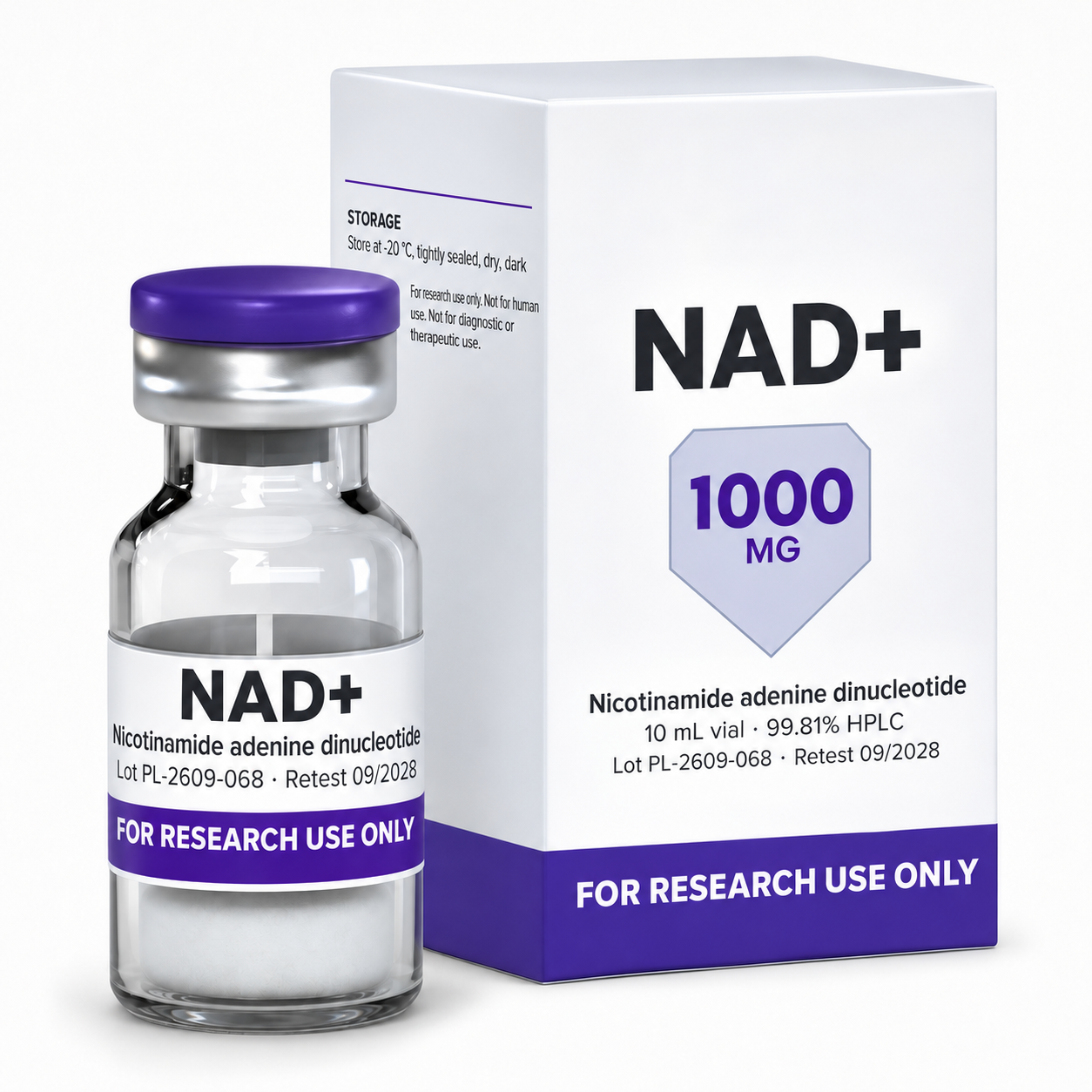
NAD+ 1,000 mg vial
One gram of NAD+ powder with the matching report for lot PL-2609-068.
- Contents
- 1,000 mg · 1 gram
- Container
- 10 mL vial
- Preparation
- Powder · reconstitution required
- Storage
- −20°C (−4°F) · dry and dark
Powder lot PL-2609-068: 99.81% HPLC area purity. No quantitative mg-per-vial content assay.
 PRODUCT IMAGE
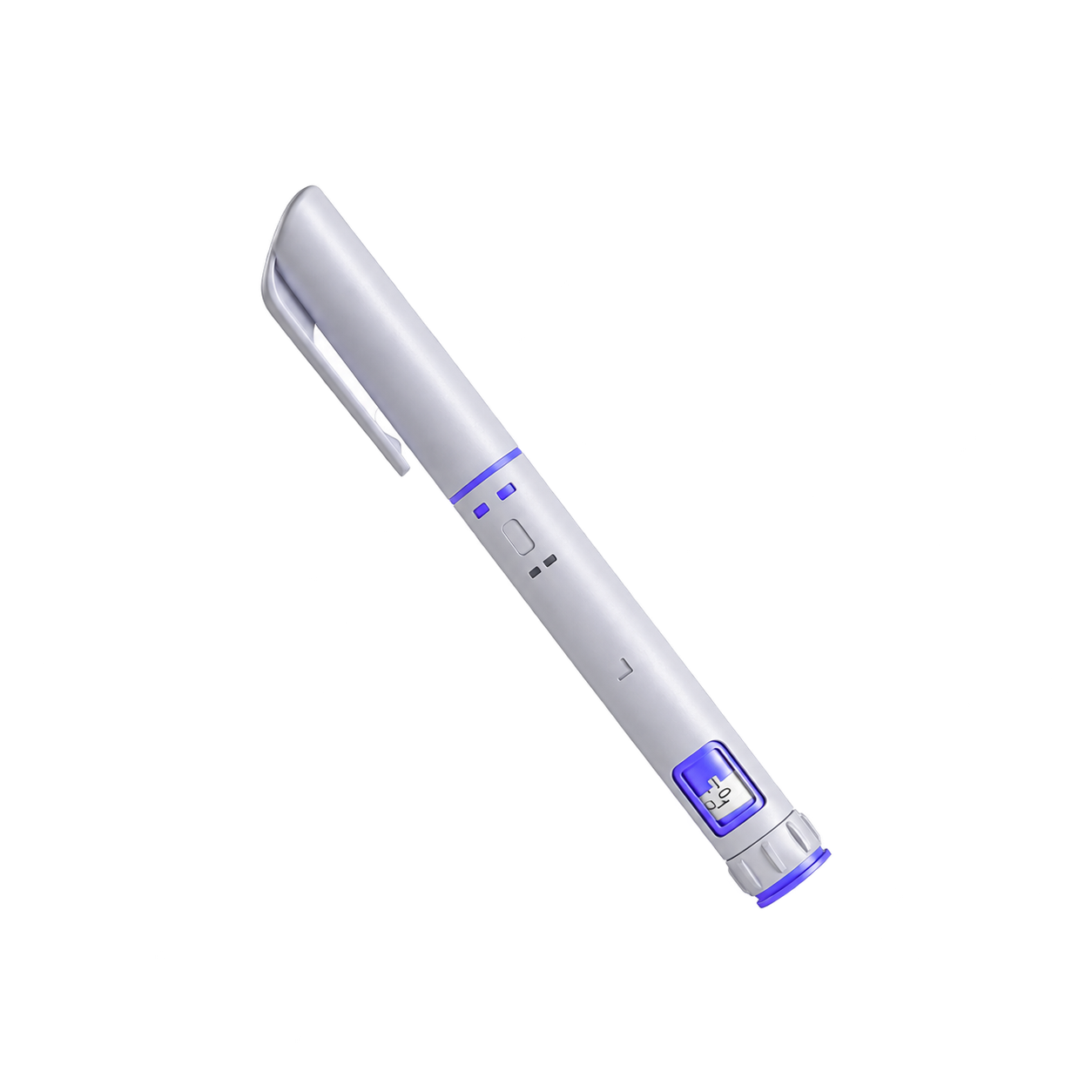
NAD+ 1,500 mg prefilled pen
3 mL of prepared solution at 500 mg/mL, with no powder-mixing step.
- Cartridge
- 3 mL · 500 mg/mL
- Solution
- Water + 0.9% benzyl alcohol
- Preparation
- Already mixed
- Storage
- 2–8°C (36–46°F) · do not freeze
Batch COA pending.
 PRODUCT IMAGE
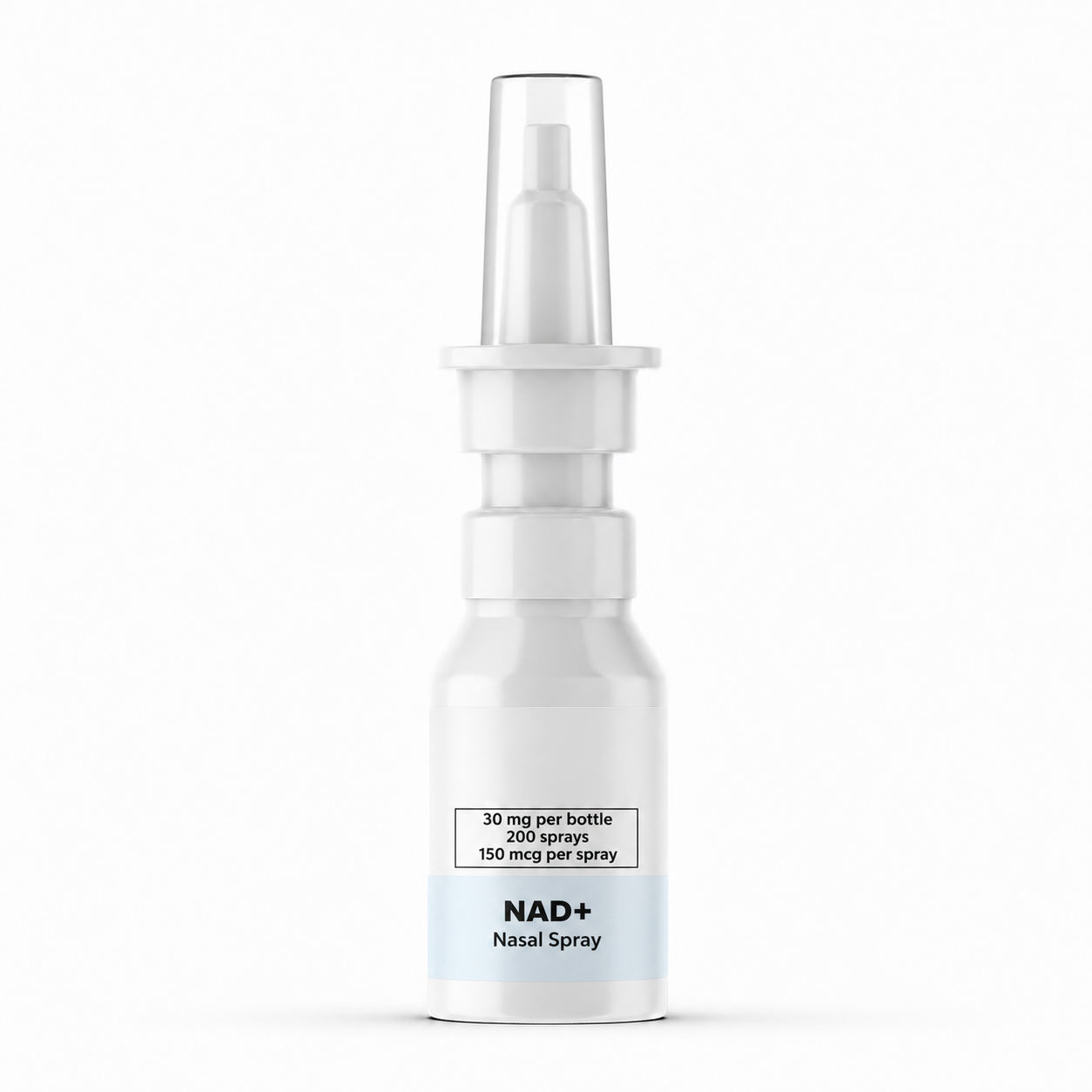
NAD+ 30 mg nasal spray
200 measured sprays, each containing 150 mcg (0.15 mg) of NAD+. Ready to use without reconstitution.
- Per spray
- 150 mcg · 0.15 mg
- Sprays per bottle
- 200
- Preparation
- Ready-made nasal solution
- Storage
- 2–8°C (36–46°F) · do not freeze
Batch COA pending.
Product photographs edited to remove supplier branding and update the displayed specifications.
The vial contains 1,000 mg of dry NAD+ powder in a 10 mL container. Its concentration is calculated after preparation from the final solution volume. The matching powder-lot COA is available below. [4]
The prefilled pen contains 1,500 mg in 3 mL at 500 mg/mL. It arrives as prepared solution, with the same total NAD+ mass as one and a half 1,000 mg vials. At that concentration, 50 mg occupies 0.1 mL and 100 mg occupies 0.2 mL. [4]
The nasal spray contains 30 mg across 200 sprays, giving 150 mcg per spray. One spray contains 0.15 mg, two contain 0.3 mg and four contain 0.6 mg. It is already mixed. The product comparison covers the amounts, preparation and storage for all three formats. [4]
Preparation and storage
Store the sealed powder at −20°C (−4°F), tightly closed, dry and protected from light. Let the closed vial reach room temperature before opening to limit condensation. [5]
For a prepared vial, record the final concentration and preparation date, refrigerate at 2–8°C (36–46°F), protect it from light and follow the discard date assigned to that preparation. The diluent and preparation method must be suitable for the intended formulation. [4]
Keep the pen and nasal spray at 2–8°C (36–46°F), capped and protected from light. Do not freeze them. Keep the spray upright. The prefilled pen requires no powder-mixing step. Discard a pen that has frozen or becomes newly cloudy or discoloured, in line with its handling instructions. [4]
The powder's retest date of 17 September 2028 applies to the sealed lot under its stated storage conditions. Follow the preparation-specific discard date once the powder has been mixed.
NAD+ combinations and overlapping ingredients
NAD+, NR and NMN are different ingredients within the same metabolic system. NR and NMN are precursors used to make NAD+. Studies of one ingredient do not establish the dosing ratio or added benefit of combining all three. [2]
Record pen and spray amounts separately: pen quantities are measured in milligrams, and each nasal spray contains 150 mcg. Different routes can produce different exposure, so adding the masses together does not predict the combined effect. Mixing compounds in the same vial also requires formulation-specific compatibility and stability data.
Claims about NAD+ restoring energy while another compound treats appetite, injury or sexual function require evidence for the actual combination. Sharing a place in a peptide catalogue does not give two compounds the same cycle length.
NAD+ side effects
Injection discomfort and IV symptoms such as nausea, abdominal cramping and chest pressure have been reported. The small injection pilot and the IV clinic series used different routes and formulations, so their experiences should not be merged into a single side-effect percentage. [2] [3]
Severe chills, shaking, vomiting and fatigue after injectable NAD+ have also been reported to the FDA in connection with contamination concerns. These reactions should not be dismissed as a normal “detox” response. Chest pain, breathing difficulty, fainting or severe shaking need prompt medical assessment. [6]
Storage, preparation quality and the solution's concentration affect a different part of the risk than the molecule's normal role in the body. The side-effects article separates reported treatment symptoms, handling problems and signs that need urgent attention.
NAD+ batch report: 1,000 mg vial
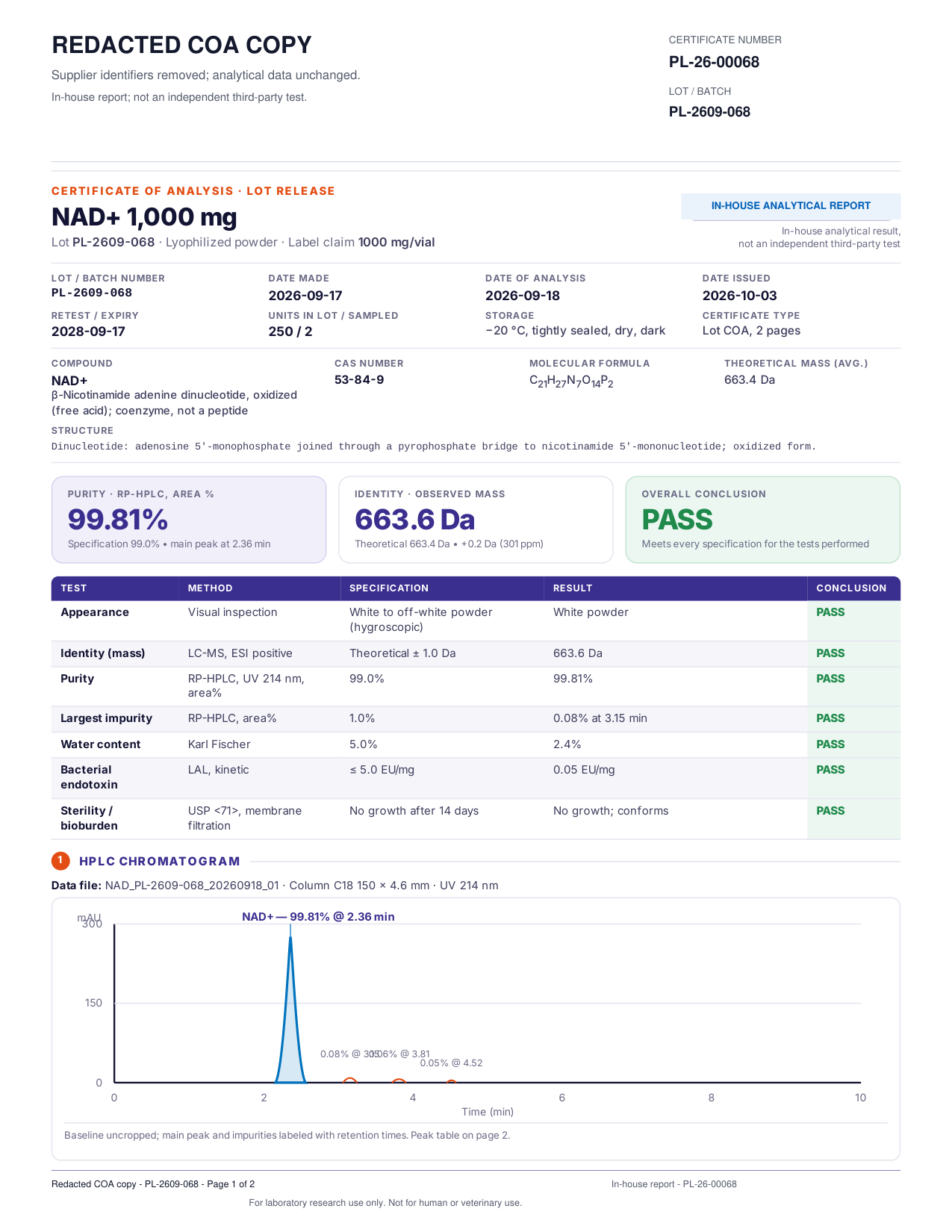
NAD+ 1,000 mg — lot PL-2609-068
2 sampled powder vials from lot PL-2609-068; in-house testing. No separate quantitative vial-fill assay, finished-pen test or finished-spray test.
Open redacted COAThe supplied report matches powder lot PL-2609-068 and records 99.81% HPLC area purity. It also lists a 663.6 Da identity result, 2.4% water, 0.05 EU/mg endotoxin and no growth after the stated 14-day sterility test. Two vials from a 250-vial lot were sampled. [5]
These are separate measurements. The purity percentage describes the proportion of the integrated chromatographic peak area; it is not a quantitative finding of 998.1 mg inside every vial. The report does not provide a separate vial-fill assay.
The public document is a clearly identified redacted copy. Supplier branding and contact details have been removed, while analytical results, dates and batch identifiers are retained. It remains an in-house powder report; no finished-pen or finished-spray certificate was supplied. The product and COA section explains that coverage.
Questions & answers.
Is NAD+ a peptide?
NAD+ is a dinucleotide coenzyme, not a peptide. It is often listed alongside research peptides because it is sold in similar vial, pen and spray formats. Its chemistry and evidence should be evaluated separately.
How much NAD+ was used in the injection pilot?
The preliminary 2026 study used 100 mg once daily for three consecutive days, administered by clinicians. Direct NAD+ groups were small: six subcutaneous, four intramuscular and five intravenous recipients. This does not establish a long-term maintenance schedule.
How many units is 100 mg of NAD+?
At 500 mg/mL, 100 mg occupies 0.2 mL, which equals 20 U-100 units. At 50 mg/mL, the same 100 mg occupies 2 mL. Concentration must be known before converting milligrams into syringe marks.
Does a 1,000 mg vial already contain liquid?
No. The 10 mL vial contains 1,000 mg of dry NAD+ powder. The 10 mL figure describes the container capacity; the final solution volume is set during preparation.
How many milligrams are in the selected pen?
The pen contains 1,500 mg in 3 mL at 500 mg/mL. At that concentration, 50 mg corresponds to 0.1 mL and 100 mg to 0.2 mL.
How much NAD+ is in each nasal spray?
Each spray contains 150 mcg, equal to 0.15 mg. The bottle contains 30 mg across 200 sprays. Two sprays contain 300 mcg, and four contain 600 mcg.
Does higher blood NAD+ mean more energy?
A blood increase confirms a biochemical change. It does not specify a matching percentage increase in energy, focus or exercise performance. Those outcomes require their own measurements and comparison group.
How long does a mixed vial last?
Follow the discard date assigned to the prepared solution. Store it at 2–8°C and protect it from light. The sealed powder’s retest date of 17 September 2028 applies to that powder lot, not to a mixed vial.
Can the vial COA be used to verify the spray or pen?
The certificate covers sampled 1,000 mg powder vials from lot PL-2609-068. Its analytical results apply to that powder lot; finished pens and sprays have a different testing scope.
Sources & batch documents7 references · expand to read
- Grant et al., 2019: direct 750 mg NAD+ infusion, plasma and urine measurements over six hours ↗
- Nkrumah-Elie et al., 2026 preprint: preliminary safety analysis of injected NR and direct NAD+; ingredient-specific groups and schedules ↗
- Reyna et al., 2026: four-day direct NAD+ and NR IV clinic-record study with 30-day follow-up ↗
- NAD+ product specifications: 1,000 mg powder vial, 1,500 mg pen and 30 mg nasal spray with 200 sprays at 150 mcg each ↗
- NAD+ 1,000 mg powder lot PL-2609-068: redacted in-house certificate, analytical results and sampling scope ↗
- FDA: unsuitable ingredients, contamination concerns and reported adverse reactions with injectable NAD+ ↗
- Yu et al., 2025/2026: randomized, placebo-controlled NAD+ trial alongside standard treatment in ischemic heart failure ↗