Jump to a section
What is Retatrutide peptide?
Retatrutide is a once-weekly investigational peptide studied for substantial weight loss, reduced appetite and improved metabolic health. It activates three hormone receptors: GLP-1, GIP and glucagon. The research name LY3437943 refers to the same compound. It is one molecule acting at three receptors, rather than a blend of three separate peptides. [1]
The largest published obesity trial reported 25.0% average weight loss at 80 weeks in its 12 mg group using an analysis that included treatment discontinuation. The analysis estimating results with continued treatment reported 28.3%, or 70.3 lb. Those figures describe monitored trial participants, not guaranteed results from an online vial or pen. [1] [2]
Retatrutide remains investigational as of this article's November 2026 research review. There is no FDA-approved retatrutide product; the supplied research formats are different from the medicine manufactured for the trials. [3]
Part of the hormone signalling involved in appetite and glucose control.
A second metabolic signal that contributes to the combined receptor activity.
Adds a different metabolic pathway to the GLP-1/GIP combination. [4]
Retatrutide benefits
Lower body weight
Large average reductions, with results reported separately for each weekly target and analysis.
Less hunger and smaller meals
Participants described feeling full sooner and eating less often. [5]
Less fat in the liver
Higher-dose groups had large relative reductions in measured liver fat at 24 weeks. [4]
Less knee pain
Trials measured improved pain and function in people with obesity and knee osteoarthritis. [1]
The practical changes extend beyond the number on the scale. A smaller waist, easier movement and less intrusive hunger are different outcomes that can matter day to day. They also need different evidence: a waist measurement, a pain score and an appetite questionnaire do not measure the same thing.
Retatrutide has also been studied in people with type 2 diabetes and sleep apnea. The benefits article separates those results from the main obesity population and explains what changed in glucose, liver fat, waist size and breathing during sleep.
How much weight did people lose?
At 80 weeks, the continued-treatment analysis found average losses of 47.2 lb at 4 mg, 64.4 lb at 9 mg and 70.3 lb at 12 mg. These corresponded to 19.0%, 25.9% and 28.3% of starting weight. Placebo averaged 5.5 lb, or 2.2%. [2]
The published primary analysis includes people who discontinued treatment and gives 17.6%, 23.7% and 25.0% for the three groups. The two sets of figures answer different questions about the same trial. Neither is a personal minimum, a maximum or a promise. [1]
For a 250 lb starting weight, a 25% reduction is 62.5 lb, leaving 187.5 lb. At 28.3%, the arithmetic is 70.75 lb lost and 179.25 lb remaining. For a 200 lb starting weight, the same percentages mean 50 lb and 56.6 lb lost. These are percentage conversions, not individual predictions. The before-and-after article provides more starting weights, time points and actual trial outcomes.
When do appetite and weight changes start?
Appetite changes can precede a large visible transformation. In a small interview study, 31 of 36 retatrutide-treated participants described eating-behaviour changes during the first eight weeks. This was a selected interview sample; it does not establish that the same proportion of all users responds within eight weeks. [5]
| Time | Observed change | Context |
|---|---|---|
| First 8 weeks | Less hunger, smaller portions or eating less often | Qualitative trial interviews |
| 24 weeks | 17.5% average weight loss | Phase 2, 12 mg target |
| 48 weeks | 24.2% average weight loss | Same phase 2 target group |
| 80 weeks | 25.0% / 28.3% average weight loss | Phase 3, 12 mg; primary / efficacy analyses |
The 24- and 48-week values come from the earlier 338-person trial; they should not be joined to the 80-week values as if they describe one continuous group. [6] The studies also increased amounts over time, so the first month was not equivalent to a month at the final target.
There is no reliable promise of a particular number of pounds in the first four weeks for an individual. An early change in hunger also does not establish how much fat has been lost. Longer follow-up is what produced the substantial averages above.
Retatrutide dosage: weekly amounts studied
Retatrutide was administered once weekly, not daily. In TRIUMPH-1, participants started at 2 mg weekly. Study investigators increased the amount every four weeks until the assigned target of 4 mg, 9 mg or 12 mg was reached. The 12 mg arm followed 2 → 4 → 6 → 9 → 12 mg across successive four-week stages. This is the research schedule, not a self-treatment instruction. [2]
The number on the container is its total content. A 30 mg vial is not a 30 mg single dose, and the 60 mg vial does not imply a different dosing schedule. Milligrams measure peptide amount; millilitres and U-100 syringe markings measure liquid volume.
At that example concentration, 2 mg occupies 0.2 mL, or 20 U-100 units. A 60 mg vial at the same 3 mL final volume is twice as concentrated: 2 mg occupies 0.1 mL, or 10 units. Keeping an old syringe number after changing strengths would change the amount.
The target-first calculator converts the amount entered into volume. The dosage article also contains the full research schedule, actual vial preparation information, the general subcutaneous-site diagram and course-quantity calculations.
Cycle length and what happens after stopping
The major weight-loss studies used months of continuing treatment. The phase 2 trial lasted 48 weeks and TRIUMPH-1 lasted 80 weeks. An eight- or twelve-week period therefore captures only the early part of these research programmes; it cannot carry their full-year result. [6] [1]
Some weight regain was already observed four weeks after treatment stopped in the liver-fat substudy. The ongoing TRIUMPH-6 study is examining continuation, a reduced amount and placebo after a longer initial treatment period. It does not yet supply a proven maintenance schedule for an online product. [4] [7]
Course quantity is a separate calculation from treatment duration. Eight weekly administrations at an unchanged 4 mg total 32 mg; eight at 9 mg total 72 mg. Escalation changes that total because the early weeks use different amounts. The course-quantity section shows the arithmetic, including the effect of the 15 mg pen's smaller total.
30 mg vial, 60 mg vial and 15 mg pen
The two vials contain powder; the pen contains 3 mL of prepared solution at 5 mg/mL. A 60 mg vial contains twice the labelled peptide of a 30 mg vial and four times the pen's 15 mg total. Their concentrations are equal only if the liquid volumes also make them equal. [8]
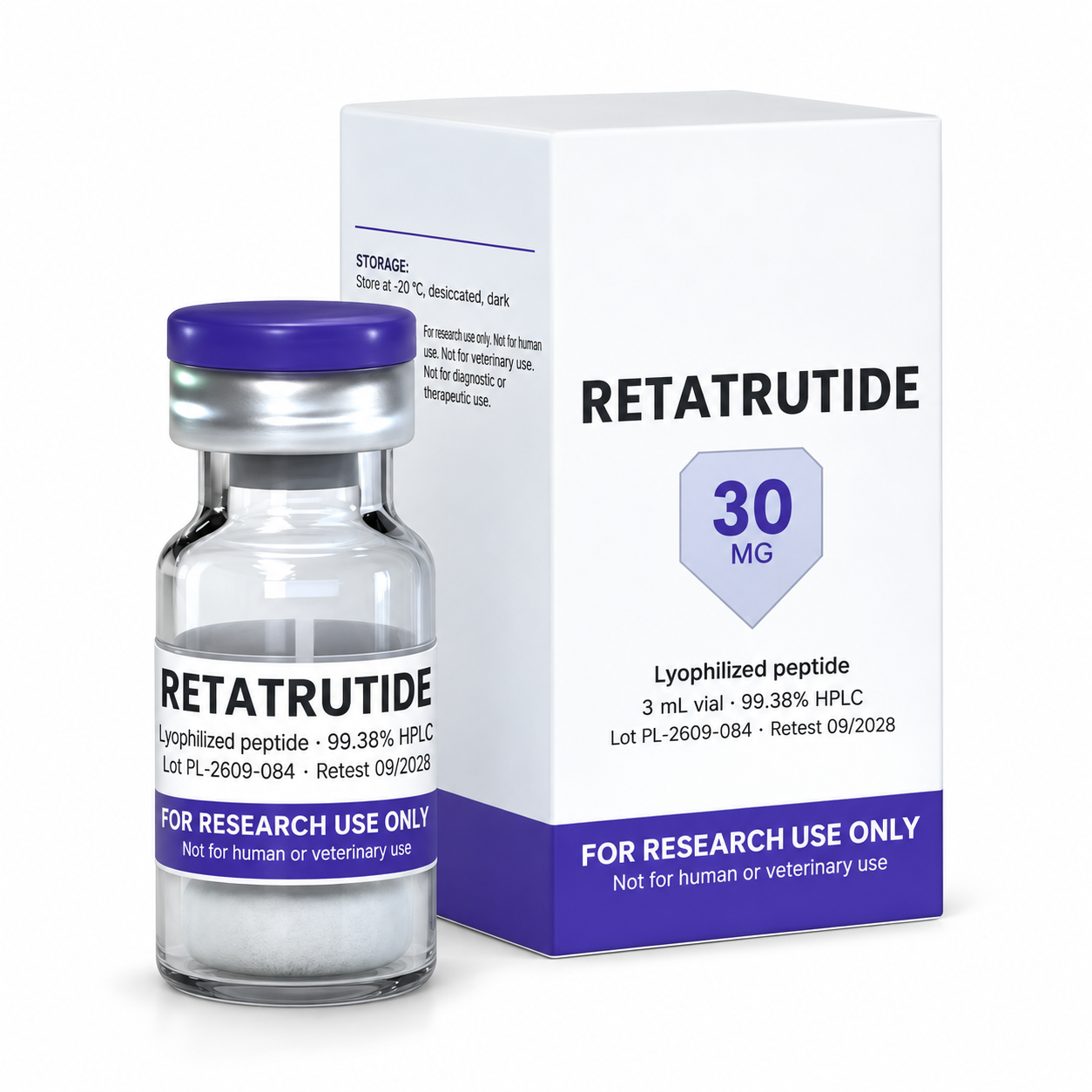 PRODUCT IMAGE
Retatrutide 30 mg vial
30 mg of single-ingredient powder with its own redacted lot report.
- Contents
- 30 mg · 30,000 mcg
- Form
- Freeze-dried powder
- Preparation
- Mixing required
- Sealed storage
- −20°C (−4°F) · dry and dark
Powder lot PL-2609-084: 99.38% HPLC area purity. No separate mg-per-vial content assay.
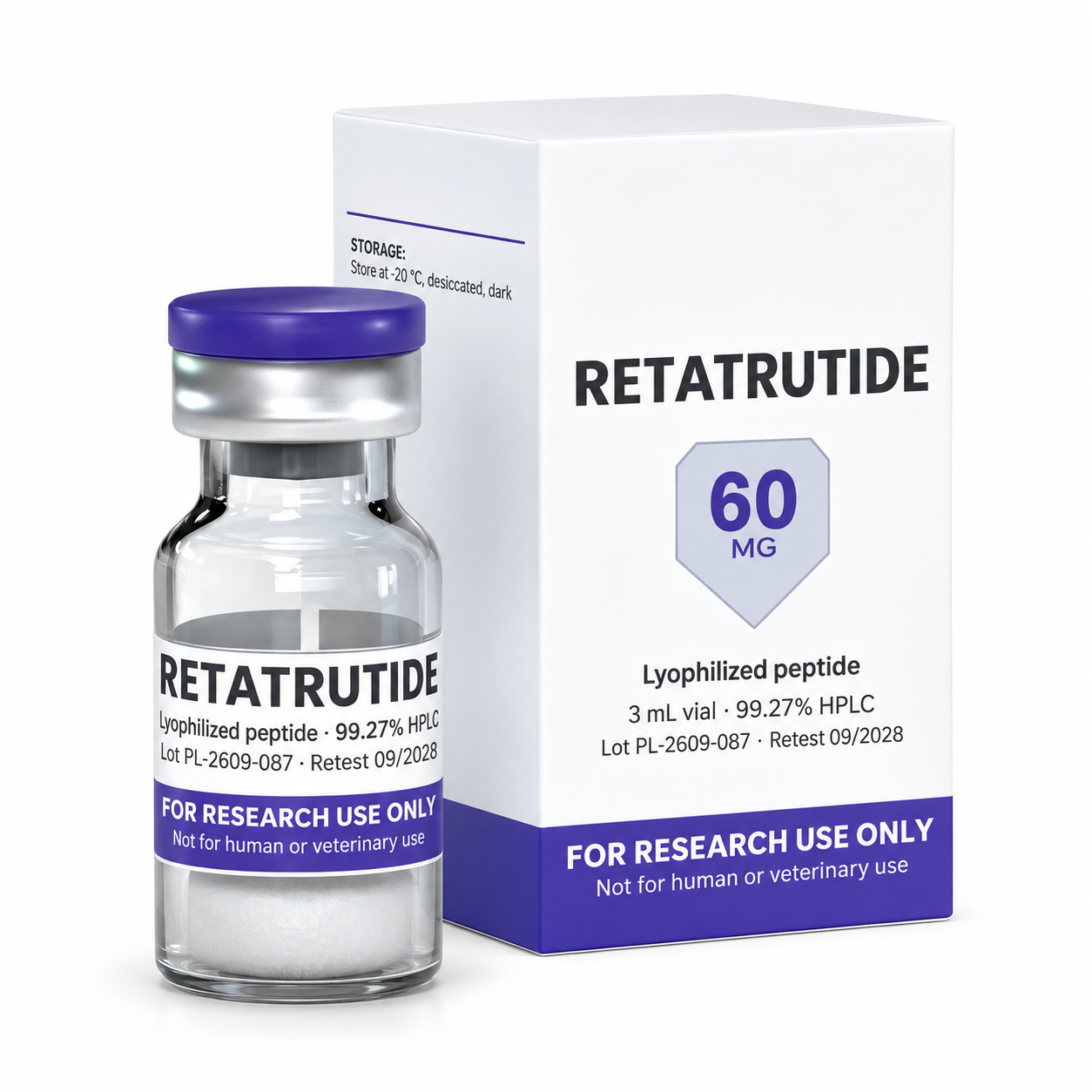 PRODUCT IMAGE
Retatrutide 60 mg vial
60 mg of single-ingredient powder with its own matching product image and lot report.
- Contents
- 60 mg · 60,000 mcg
- Form
- Freeze-dried powder
- Preparation
- Mixing required
- Sealed storage
- −20°C (−4°F) · dry and dark
Powder lot PL-2609-087: 99.27% HPLC area purity. No separate mg-per-vial content assay.
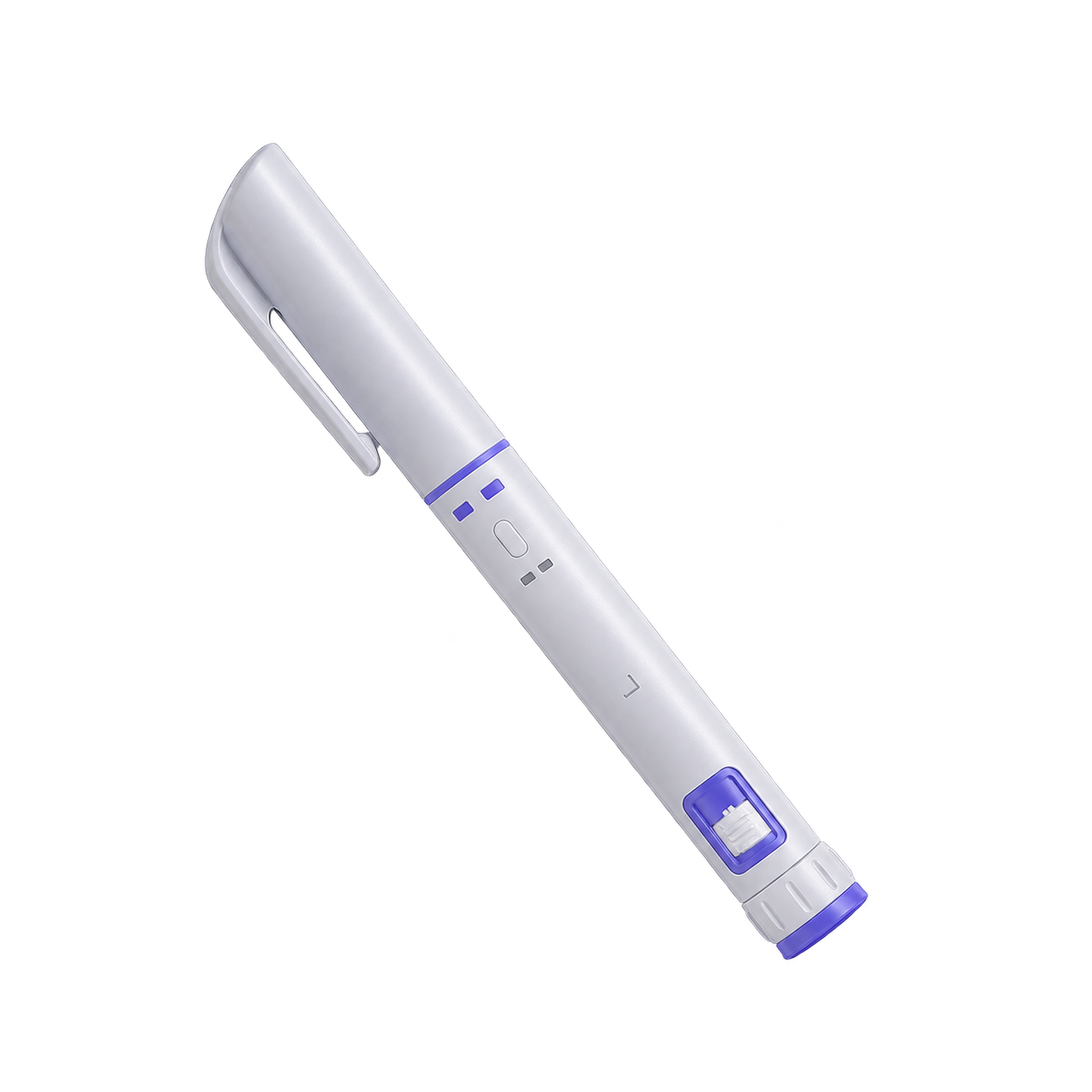 PRODUCT IMAGE
Retatrutide 15 mg prefilled pen
3 mL of prepared solution at 5 mg/mL. No powder-mixing step.
- Cartridge
- 3 mL · 5 mg/mL
- Solution
- Water + 0.9% benzyl alcohol
- Preparation
- Already mixed
- Storage
- 2–8°C (36–46°F) · do not freeze
Batch COA pending.
Product photographs edited to remove supplier branding. Any unresolved specifications are identified on the product card.
A larger vial can reduce the number of containers required for a specified total. It does not show that a prepared solution remains usable long enough to consume all of it. The labelled sealed-powder expiry, post-mixing stability and first-puncture limit are different questions.
The pen removes the powder-mixing step, but its total concentration does not establish a mechanical click setting. At 5 mg/mL, a 2 mg amount corresponds mathematically to 0.4 mL. The exact dial calibration and maximum deliverable volume require device-specific documentation. Full specifications and product images with supplier branding removed appear on the Buy Retatrutide page.
Weight loss, belly fat and muscle
A lower body weight is not the same as losing only fat. In a body-composition substudy involving people with type 2 diabetes, retatrutide reduced measured fat mass, but lean tissue also decreased. The proportion of lean loss was similar to that seen with other obesity treatments. These findings do not support a zero-muscle-loss claim. [9]
The liver MRI substudy separately measured fat inside the liver and abdominal fat compartments. Those measurements explain why a smaller waist and better liver-fat result can accompany weight reduction, but a percentage reduction in liver fat is not a percentage reduction in total body weight. [4]
A weight-loss result also cannot predict exactly how loose skin, facial fullness or abdominal shape will change. The trials did not turn a given number of pounds lost into a guaranteed cosmetic appearance. The results page uses measured data rather than invented transformation product images.
Retatrutide versus other weight-loss peptides
Retatrutide and tirzepatide are different molecules. Tirzepatide activates GIP and GLP-1 receptors; retatrutide also activates the glucagon receptor. Their milligram amounts are not interchangeable. The direct retatrutide-versus-tirzepatide trial is TRIUMPH-5; a larger result in a separate trial does not establish head-to-head superiority. [10] [11]
Adding a second GLP-1-related medicine does not recreate retatrutide's tested formulation. The Zepbound prescribing information advises against coadministration with another GLP-1 receptor agonist. It should not be used as the basis for an improvised overlapping regimen. [10]
Tesamorelin has a different mechanism and clinical purpose. A study of deep abdominal fat in a specific medical population does not provide a substitute retatrutide schedule or predict the same change in overall body weight.
Common side effects and tolerability
Nausea, diarrhea, constipation and vomiting were the main digestive effects in TRIUMPH-1. Skin sensitivity, burning or other unusual sensations were also reported. The chance of an adverse event and the chance of stopping treatment are different numbers. [2]
Digestive symptoms
Nausea and bowel changes can interfere with eating and hydration.
Skin sensitivity
Unusual tingling, burning or sensitivity deserves its own assessment.
Heart-rate changes
The phase 2 study recorded dose-related increases that peaked during treatment. [6]
The side-effects article gives dose-specific percentages, practical symptom guidance and the distinction between routine discomfort and symptoms needing prompt medical attention. A purity percentage on a vial does not predict how a person will tolerate the compound.
Redacted Retatrutide COAs
The 30 mg and 60 mg vials have separate source reports. Lot PL-2609-084 corresponds to the 30 mg product and reports 99.38% HPLC area purity. Lot PL-2609-087 corresponds to the 60 mg product and reports 99.27%. Both redacted PDFs retain the analytical data. [12] [13]
These in-house reports record identity, chromatographic purity, water, endotoxin and sterility findings for sampled powder vials. They do not contain a separate measured-milligrams-per-vial assay, and they do not test the prepared pen. The batch-report section places each PDF beside its matching product and explains the measurements separately.
Questions & answers.
How much weight can someone expect to lose on retatrutide?
The 80-week 12 mg trial group averaged 25.0% in the primary analysis including discontinuation, and 28.3% in the continued-treatment analysis. For a 250 lb starting weight, those percentages mathematically equal 62.5–70.75 lb. Individual outcomes vary; this is not a guaranteed range.
Is retatrutide taken daily or weekly?
The major clinical trials used once-weekly subcutaneous administration. The product total in a 30 mg or 60 mg vial is not the amount administered at one time.
What starting amount was used in TRIUMPH-1?
The trial started participants at 2 mg once weekly and increased the amount at four-week intervals toward an assigned target of 4 mg, 9 mg or 12 mg. Those are research protocols under study supervision, not a personal prescription.
How many units is 2 mg?
At 30 mg in 3 mL, 2 mg is 0.2 mL or 20 U-100 units. At 60 mg in 3 mL, it is 0.1 mL or 10 units. The vial amount and final solution volume must both be known.
Does the pen contain 30 mg or 60 mg?
Neither. The supplied pen contains 15 mg in 3 mL at 5 mg/mL. The 30 mg and 60 mg products are separate powder vials.
Is 99% purity proof of an exact vial fill?
No. HPLC area purity describes the proportion of the integrated chromatogram attributed to the main peak. The supplied reports do not include a separate quantitative assay confirming the exact milligrams in each vial.
Will an eight-week cycle produce the reported 25–28% loss?
The headline phase 3 figures were measured after 80 weeks. Eight weeks is much earlier, during dose escalation for the higher-target groups, and the long-term average cannot be assigned to that shorter duration.
Sources & batch documents13 references · expand to read
- Jastreboff et al. — TRIUMPH-1 randomized phase 3 trial, NEJM, 29 September 2026 ↗
- TRIUMPH-1 sponsor results — efficacy and treatment-regimen analyses, 21 May 2026 ↗
- FDA — concerns with unapproved GLP-1 drugs, including retatrutide ↗
- Sanyal et al. — randomized retatrutide liver-fat MRI substudy, Nature Medicine 2024 ↗
- Goetz et al. — interviews with phase 2 trial participants, Obesity Pillars 2025 ↗
- Jastreboff et al. — 48-week randomized obesity trial, NEJM 2023 ↗
- TRIUMPH-6 — ongoing retatrutide maintenance study, NCT06859268 ↗
- Product specifications — 30 mg vial, 60 mg vial and 15 mg / 3 mL pen ↗
- Coskun et al. — DXA fat and lean-mass substudy in type 2 diabetes, 2025 ↗
- Zepbound prescribing information — receptor activity and coadministration restrictions ↗
- TRIUMPH-5 — retatrutide compared with tirzepatide, NCT06662383 ↗
- Redacted two-page 30 mg powder report — lot PL-2609-084 ↗
- Redacted two-page 60 mg powder report — lot PL-2609-087 ↗