Jump to a section
Buy GHK-Cu peptide: compare the three formats
The vial supplies 100 mg of powder. The pen supplies 150 mg in 3 mL, already mixed at 50 mg/mL. The nasal spray is listed as 100 mg per bottle, with its received-label details and pump output still to be confirmed. All three are research-labelled products. [1]
Online ordering is not available yet.
GHK-Cu 100 mg vial
Blue freeze-dried powder. Redacted two-page lot report included below.
- Form
- Blue freeze-dried powder
- Preparation
- Reconstitution required
- Sealed storage
- −20°C (−4°F) · dry · dark
- Documented powder lot
- PL-2609-036
Source report for two sampled powder vials from lot PL-2609-036.
GHK-Cu 150 mg prefilled pen
3 mL of prepared blue solution at 50 mg/mL. No powder-mixing step.
- Cartridge
- 3 mL · 50 mg/mL
- Solution
- Water + 0.9% benzyl alcohol
- Preparation
- Already mixed
- Storage
- 2–8°C (36–46°F) · do not freeze
Powder-lot reference only. The report does not test the finished pen or establish its lot linkage.
GHK-Cu nasal spray — listed 100 mg
Prepared nasal format. Confirm the bottle label; micrograms per pump are unverified.
- Listed total
- 100 mg · confirm bottle label
- Solution
- Water + 0.9% benzyl alcohol
- Amount per pump
- Not confirmed
- Storage
- 2–8°C (36–46°F) · do not freeze
Powder-lot reference only. The report does not establish bottle content, batch linkage or amount per spray.
Research-labelled products. Drawings show the formats; they are not product photographs.
Powder, prepared pen or nasal spray
| Specification | 100 mg vial | 150 mg pen | Nasal spray |
|---|---|---|---|
| GHK-Cu total | 100 mg label claim | 150 mg stated total | Listed as 100 mg |
| Arrives as | Blue powder | Blue solution | Blue solution |
| Liquid volume | Depends on preparation | 3 mL | Exact fill unconfirmed |
| Concentration | Depends on final volume | 50 mg/mL | Exact value unconfirmed |
| Mixing | Required | Already prepared | Already prepared |
| Supplied lot report | Powder lot PL-2609-036 | Powder reference only | Powder reference only |
The practical trade-off is preparation and measurement. The vial leaves the final concentration dependent on the preparation method. The pen removes that mixing step and fixes concentration at 50 mg/mL. The spray uses a pump, but its amount per press is not verified. A convenient package does not establish better absorption or stronger results.
GHK-Cu 100 mg vial
One sealed vial contains blue freeze-dried copper-peptide powder. Its 100 mg label refers to the GHK-Cu complex. The supplied certificate identifies Gly-His-Lys bound to copper in a 1:1 complex; it does not describe a 100 mg elemental-copper supplement. [2]
100 mg
GHK-Cu complex in one powder vial.
50 mg/mL
Concentration when the final mixed volume is 2 mL.
0.04 mL
Four U-100 units at that concentration; arithmetic, not a selected dose.
An alternative final volume of 3 mL would produce approximately 33.33 mg/mL. The same 2 mg target would occupy 0.06 mL, or six U-100 units. These examples explain why copying a syringe marking from another vial can change the amount. More liquid dilutes the solution without increasing its 100 mg total.
The supplied records do not specify a validated mixing liquid or expiry after preparation. Check the vial preparation details, then calculate the volume for your target amount.
GHK-Cu 150 mg pen: 3 mL at 50 mg/mL
The pen contains 50% more GHK-Cu than one 100 mg vial. The liquid contains water and 0.9% benzyl alcohol; no water is added to the cartridge. Its 50 mg/mL label is a concentration, not the total pen amount. [1]
On the supplied device configuration, 300 marked units span 3 mL. One marked unit represents 0.01 mL and 500 mcg GHK-Cu. Four marked units represent 2 mg; ten represent 5 mg. A mechanical click has not been confirmed equal to one marked unit.
A 2 mg calculation gives 75 mathematical portions from 150 mg, before priming, residual liquid and discard limits. That count does not establish a 75-day treatment course. The pen matches the 100 mg/2 mL vial example at 50 mg/mL. A vial mixed to 3 mL would be less concentrated, so the same target would need a larger volume.
GHK-Cu nasal spray: confirm the amount per pump
The current listing names a 100 mg spray; the exact received-bottle label still needs confirmation. The prepared liquid contains water with 0.9% benzyl alcohol. Its blue colour is expected for this copper complex. [1]
Bottle total ≠ amount per spray
Concentration in mg/mL × pump volume in mL = mg released per press. Exact concentration and calibrated pump volume are both missing.
The safety sheet's “below 10%” concentration and nominal 10 mL minimum fill support hazard classification. They do not establish the actual bottle volume or a 625 mcg pump amount. Neither a generic spray chart nor a different peptide's nozzle can supply those missing specifications.
The spray offers an already prepared format, but a bottle total cannot tell you its usable press count or how much reaches the bloodstream. Those questions require finished-product measurements and route-specific data. Keep the spray's amount separate from the pen's marked-unit scale.
GHK-Cu alone, GLOW and KLOW
These products contain standalone GHK-Cu. GLOW and KLOW contain additional peptides. In the existing range, the 70 mg GLOW vial contains 50 mg GHK-Cu, 10 mg BPC-157 and 10 mg TB-500. The 80 mg KLOW vial adds 10 mg KPV to those amounts.
| Powder vial | GHK-Cu | Other peptide content |
|---|---|---|
| GHK-Cu 100 mg | 100 mg | None listed |
| GLOW 70 mg | 50 mg | 20 mg combined |
| KLOW 80 mg | 50 mg | 30 mg combined |
One standalone vial therefore contains twice the labelled GHK-Cu in either blend vial. A 2 mg GHK-Cu amount corresponds to 2.8 mg total GLOW or 3.2 mg total KLOW at those ratios. The other ingredients rise with that blend amount. Use the matching product calculator.
A cosmetic serum is another distinct formulation. None of these three products is a finished facial serum, and a vial's powder label does not provide a validated recipe for adding it to skincare.
Read milligrams and percentages correctly
100 mg is a total amount; 50 mg/mL is a concentration; 5% w/v means 5 g per 100 mL. The pen’s 50 mg/mL and 5% w/v describe the same concentration. A powder vial cannot have a liquid percentage until its final volume is known.
For a cosmetic, check the declared GHK-Cu concentration. A percentage naming a multi-ingredient complex does not give the GHK-Cu amount by itself. The research products here provide no validated cosmetic formulation or equivalence to a finished serum.
Compare price per milligram and usable quantity
Divide the vial price by 100 and the pen price by 150. That gives price per labelled milligram. A pen priced at 1.5 times the vial price has the same cost per milligram; below that ratio the pen is cheaper by content, above it the vial is.
Two pens and three vials each represent 300 mg GHK-Cu. They differ in preparation costs and usable life. Diluent, measurement equipment, delivery, priming losses and discarded remainder can change the practical cost. The larger package only provides value if its contents remain usable.
For the spray, confirm the bottle label before using 100 mg in a price calculation. Without pump calibration, price per measured spray cannot be calculated.
Keep powder frozen and prepared liquid refrigerated
−20°C / −4°F
Keep dry and protected from light. Allow the closed vial to reach room temperature before opening to reduce condensation.
2–8°C / 36–46°F
Keep capped and out of light; spray upright, pen in its carton. Do not freeze either prepared format.
The powder lot's retest date is 16 September 2028 under its specified storage conditions. It is not an expiry for a mixed vial or opened device. No universal 28-day in-use period is supplied. Set aside cloudy liquid or liquid with an abnormal colour change. Normal blue colour alone cannot prove sterility or strength. [1] [2]
Redacted GHK-Cu certificate of analysis
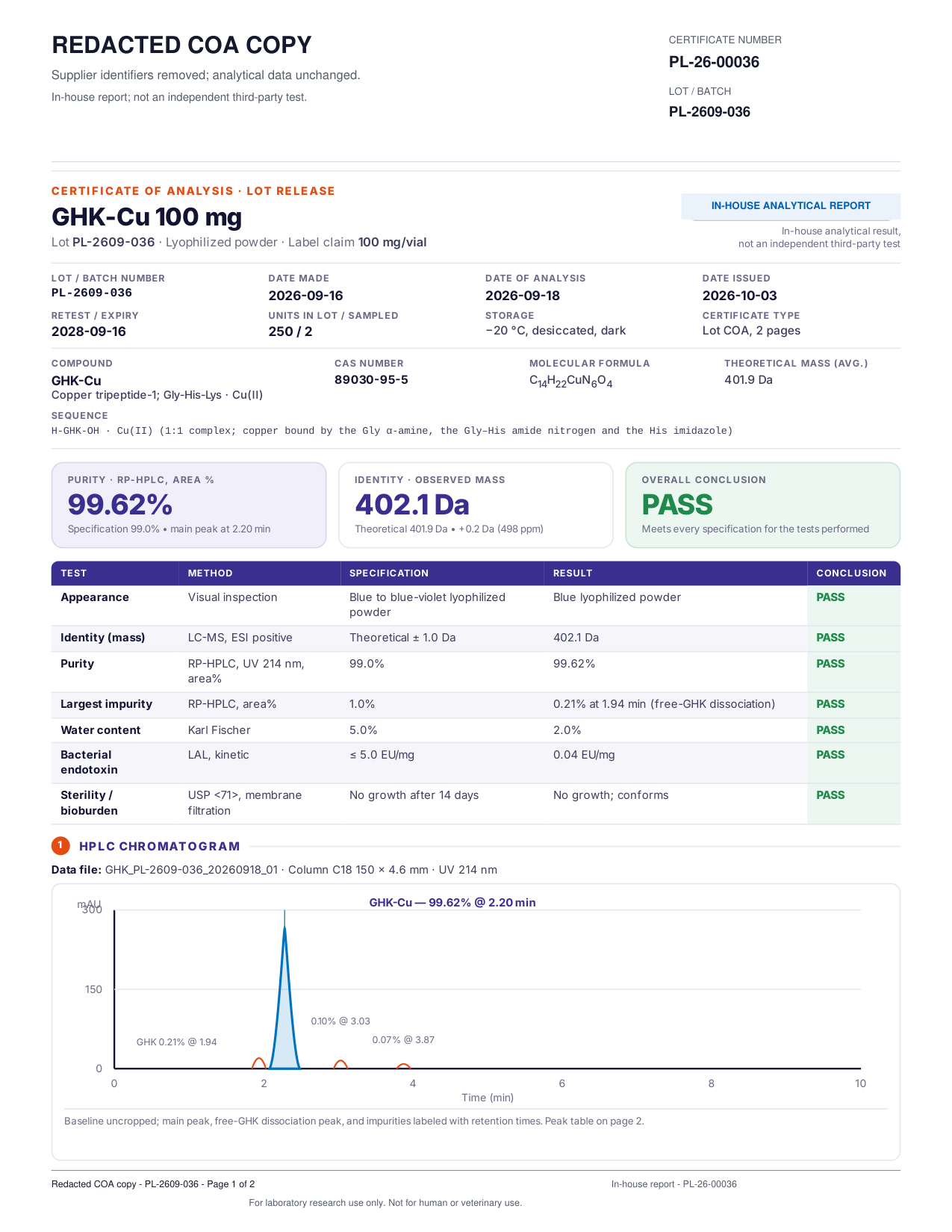
GHK-Cu — powder lot PL-2609-036
Two sampled powder vials from lot PL-2609-036. This report does not establish finished-pen or finished-spray content, sterility, stability, pump calibration or batch linkage.
Open redacted COACertificate PL-26-00036 covers two powder vials sampled from lot PL-2609-036, containing 250 units. Testing recorded 99.62% RP-HPLC area purity, 402.1 Da identity by mass spectrometry, 2.0% water, 0.04 EU/mg endotoxin and no growth after 14 days in the sterility test. [2]
The 99.62% figure is chromatogram peak area. It is not a direct assay of 99.62 mg per vial or the copper percentage. The largest additional peak is 0.21%, identified in the report as free-GHK dissociation. The two remaining peaks are 0.10% and 0.07%.
The report identifies the copper complex at a theoretical mass of 401.9 Da. It does not separately measure elemental copper or verify the labelled fill by quantitative content assay. Its microbial tests answer different questions from its identity and purity tests.
This is an in-house report with no external laboratory attachment. The redacted two-page PDF preserves the analytical data. It appears beside the pen and spray as a powder-lot reference; it does not establish their finished-product testing, pump accuracy or batch linkage.
Questions & answers.
Does the GHK-Cu pen contain 50 mg or 150 mg?
150 mg total. The concentration is 50 mg/mL and the cartridge holds 3 mL. Multiplying the two gives the full pen amount.
Is one pen equivalent to one 100 mg vial?
By labelled content, one pen equals one and a half vials. Preparation, measurement and usable life still differ.
Is the 100 mg label elemental copper?
No. It names the GHK-Cu complex. The supplied certificate does not include a separate elemental-copper assay.
How much GHK-Cu does one nasal-spray press release?
The amount is unverified. The listing states 100 mg per bottle, but the received label, liquid concentration and calibrated pump volume need confirmation.
Does the redacted COA test the pen and spray?
No. It tests sampled powder vials from lot PL-2609-036. Finished-device content, sterility, stability and lot linkage are not established.
Are needles, diluent and other supplies included?
The pen specification describes a fitted needle. Extra needles, mixing supplies and accessory quantities are not confirmed.