Jump to a section
Buy PT-141: 10 mg vial or nasal spray
The vial contains 10 mg of PT-141 powder and has a matching redacted COA. The nasal product is supplied as prepared liquid, but its written specifications and bottle images disagree about the amount and ingredients. That conflict needs resolving before assigning a spray strength. [1]
Online ordering is not available yet.
 PRODUCT IMAGE
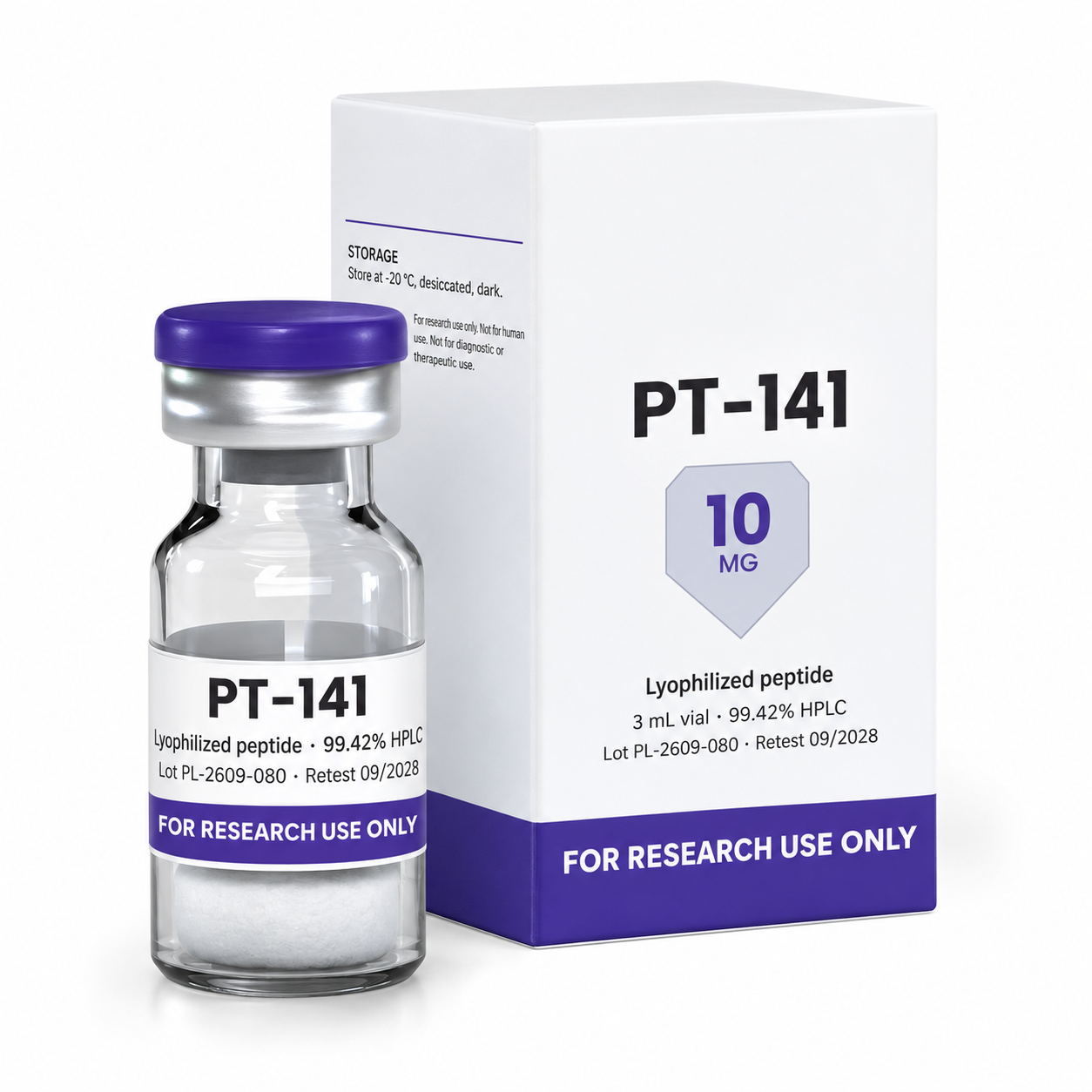
PT-141 10 mg vial
10 mg of bremelanotide powder with the matching source report for lot PL-2609-080.
- Contents
- 10 mg · 10,000 mcg
- Form
- Freeze-dried powder
- Preparation
- Mixing required
- Sealed storage
- −20°C (−4°F) · dry and dark
Powder lot PL-2609-080: 99.42% HPLC area purity. No separate mg-per-vial content assay.
 PRODUCT IMAGE
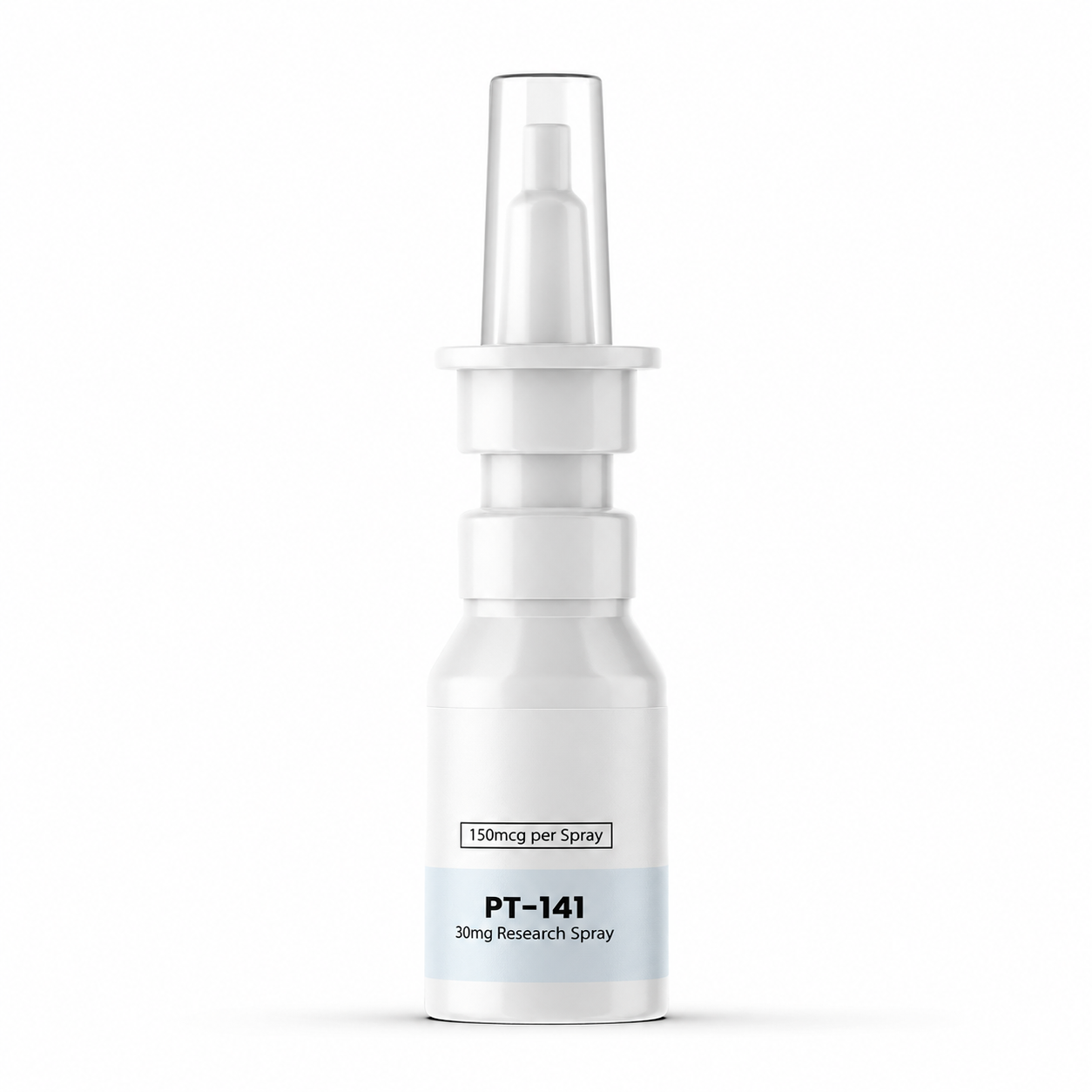
PT-141 nasal spray
Ready-made spray. The written specifications and original bottle image show different strengths and preservatives.
- Form
- Prepared nasal solution
- Per spray
- Current calibration unconfirmed
- Mixing
- No powder to dissolve
- Storage
- 2–8°C (36–46°F) · do not freeze
Written information says 10 mg with benzyl alcohol; the original images show 30 mg, 150 mcg per spray, saline and methylparaben. Current-lot strength and formulation need confirmation.
Batch COA pending.
Product photographs edited to remove supplier branding. Any unresolved specifications are identified on the product card.
| Comparison | 10 mg vial | Nasal spray |
|---|---|---|
| Form supplied | Freeze-dried powder | Prepared liquid |
| Total PT-141 | 10 mg / 10,000 mcg | Unresolved: written 10 mg versus pictured 30 mg |
| Preparation | Known final volume required | No powder to dissolve |
| Amount per measurement | Depends on final concentration | Current pump calibration unconfirmed |
| Redacted matching COA | Powder lot PL-2609-080 | Finished-spray report not supplied |
PT-141 and bremelanotide name the same peptide. Product format changes how it is prepared and measured. The main PT-141 guide explains its effects on desire and arousal; the dosage page separates approved injection instructions, research amounts and vial calculations.
PT-141 10 mg powder vial
10 mg bremelanotide · one sealed vial · lot PL-2609-080. The powder is white in the attached lot report, which records 99.42% HPLC area purity and an identity mass of 1025.4 Da. The original vial and carton image matches that amount, lot and purity figure. [2]
The 3 mL description on the packaging is the container size. It does not mean the vial already contains 3 mL of liquid or that 3 mL must be added. The concentration is calculated from the final solution volume: 10 mg in 2 mL gives 5 mg/mL; 10 mg in 1 mL gives 10 mg/mL.
The last calculation uses a U-100 scale, where 100 units equals 1 mL. Those numbers are concentration arithmetic, not a validated preparation recipe. Use the vial calculator with the actual total, final volume and target amount. A larger liquid volume makes the solution more dilute; it does not change the 10 mg total.
PT-141 nasal spray: strength needs confirmation
The written specifications say 10 mg per bottle; the original image says 30 mg and 150 mcg per spray. A second supplied product image shows 200 sprays and 30,000 mcg, consistent with the pictured 30 mg total. The written 10 mg description is one third of that amount. [1]
| Specification | Written product information | Original image labels |
|---|---|---|
| Total content | 10 mg per bottle | 30 mg per bottle |
| Spray output | No confirmed amount per actuation | 150 mcg; 200 sprays pictured |
| Other ingredients | Water and 0.9% benzyl alcohol | Saline and methylparaben |
A current lot-specific label needs to establish which strength and formulation is actually supplied. It must also establish the filled volume and the amount delivered by the pump.
Do not convert an injection amount into a spray count from these conflicting figures. The safety data sheet uses a nominal 10 mL fill for hazard calculations and allows larger fills; it does not verify this bottle's actual volume. Neither the powder-vial certificate nor the word “metered” establishes the finished spray's concentration, output accuracy or absorption.
Is a PT-141 vial the same as Vyleesi?
Vyleesi is a specific prescription bremelanotide product: 1.75 mg in 0.3 mL in a single-dose autoinjector. Its indication covers premenopausal women with acquired, generalized low sexual desire causing distress, under the conditions defined in its prescribing information. The two formats here are research-labelled products; neither is that approved autoinjector. [3]
The distinction changes the measurement. A 0.3 mL volume of a 5 mg/mL vial solution contains 1.5 mg, so the approved pen's liquid volume cannot be copied into a different concentration. Likewise, published injection results do not establish what an unverified nasal formulation will do. The results article gives the actual study outcomes and routes.
How many portions are in a 10 mg vial?
At an example amount of 1.75 mg, 10 mg contains five complete portions and a 1.25 mg remainder. Dividing 10 by 1.75 gives about 5.71 mathematical portions; it does not give six full 1.75 mg portions.
For quantity planning, multiply the amount by the number of measurements. Four 1.75 mg portions require 7 mg; eight require 14 mg. These are examples of total-material arithmetic. They do not set a treatment frequency or establish that an opened vial remains usable long enough to provide all the portions.
Transfer losses, residual liquid and a validated discard date affect usable yield. A count of nasal applications cannot be supplied while the bottle's actual strength and pump output are unresolved.
PT-141 price per milligram
For the 10 mg vial, divide a quoted price by 10 to obtain the cost per labelled milligram. Multiplying that figure by 1.75 gives the peptide-only cost of a 1.75 mg arithmetic portion, before supplies, losses or discarded remainder.
A fair nasal comparison needs confirmed total content first: dividing the same price by 10 or 30 produces a threefold difference. Price per milligram also does not measure how much reaches the bloodstream through different routes. Prices and online ordering are not available yet.
Storage for powder and nasal spray
−20°C / −4°F
Keep the 10 mg vial dry and protected from light. Bring the sealed vial to room temperature before opening to reduce condensation.
2–8°C / 36–46°F
Keep upright, capped and protected from light. The spray storage specification says not to freeze it.
Prepared vial solutions also have a 2–8°C, light-protected storage instruction. Their usable period depends on a validated preparation method; the supplied documents do not establish a universal 28-day or 60-day opened life. [1]
The powder certificate's retest/expiry date is 18 September 2028 under its stated storage conditions. That date does not transfer to a mixed vial or an opened nasal bottle. Preservative ingredients and a clear-looking solution do not, by themselves, prove stability or sterility. [2]
Redacted PT-141 certificate of analysis
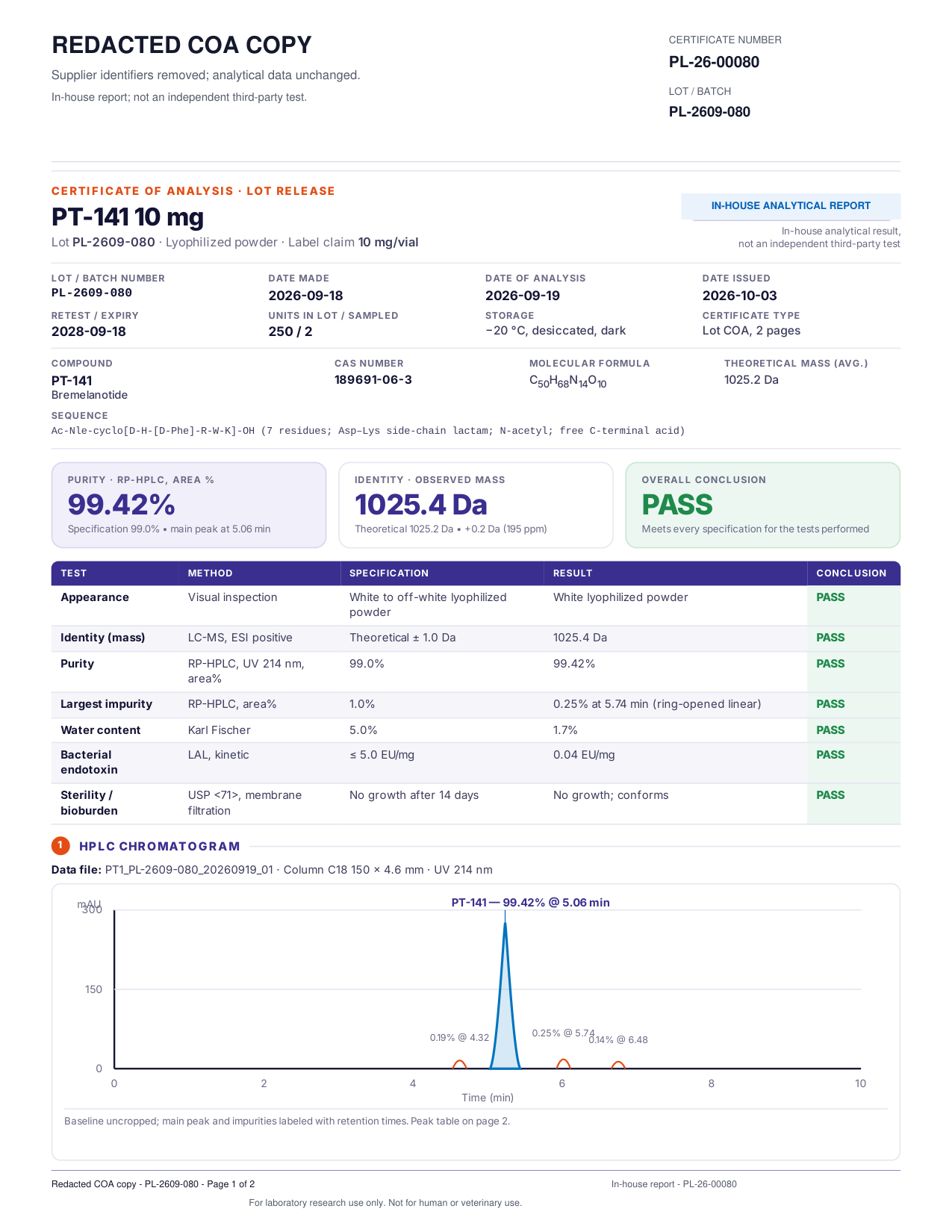
PT-141 10 mg — lot PL-2609-080
2 sampled powder vials from lot PL-2609-080; in-house testing. No separate quantitative vial-fill assay or finished-spray testing.
Open redacted COACertificate PL-26-00080 covers two sampled powder vials from a lot of 250. The lot is PL-2609-080, manufactured on 18 September 2026. The main analysis is dated 19 September; the report was issued on 3 October 2026. The redacted two-page PDF preserves the analytical data. [2]
The report lists 99.42% HPLC area purity, 1025.4 Da observed identity mass, 1.7% water and 0.04 EU/mg endotoxin. It records no growth after 14 days under the stated USP <71> sterility method. The additional-test dates are 20 September for water, 21 September for endotoxin and 2 October for sterility.
The printed chromatography figures reconcile: the main peak area of 4,275,060 divided by the total area of 4,300,000 gives exactly 99.42%. The largest reported impurity is a ring-opened linear form at 0.25%. This arithmetic check confirms consistency within the document; it is not a new laboratory test.
Purity and vial content answer different questions. HPLC area percentage describes the relative chromatogram peaks. The report does not give a separate quantitative result proving the vial contains exactly 10 mg. Testing was performed in-house, with no independent laboratory report attached. Its findings apply to the named powder samples and do not establish finished-spray strength, preservatives, sterility or pump performance.
Questions & answers.
Are PT-141 and bremelanotide the same ingredient?
Yes. PT-141 is the development code for bremelanotide. The name alone does not identify the product formulation, route, strength or manufacturing standard.
Does a 10 mg vial contain ten doses?
No. Ten milligrams is the total labelled amount. The number of complete portions depends on the amount per calculation: at 1.75 mg, the mathematical yield is five full portions plus a 1.25 mg remainder, before losses.
Is this nasal bottle 10 mg or 30 mg?
That is unresolved. Written specifications give 10 mg, while the product images with supplier branding removed show 30 mg, 150 mcg per spray and 200 sprays. A current lot-specific label and pump specification are needed to confirm the supplied bottle.
Does 99.42% purity mean 9.942 mg in the vial?
No. The percentage is an HPLC area result, not a quantitative fill-content assay. Multiplying it by the 10 mg label claim does not create a measured content result.
Does the redacted COA cover the nasal spray?
No. It covers two powder-vial samples from lot PL-2609-080. No document supplied here links that lot to a finished spray or tests the filled bottle and pump.
Can the vial calculator calculate nasal sprays?
No. It converts a known vial amount, final solution volume and target amount into millilitres and U-100 units. Nasal actuations require their own verified concentration and pump output; absorption is a separate question.