Jump to a section
Buy MOTS-C: 40 mg vial or 30 mg pen
The 40 mg vial contains freeze-dried MOTS-C. The prefilled pen contains 30 mg in 3 mL at 10 mg/mL. The vial gives you 10 mg more peptide and a concentration selected during preparation. The pen arrives as a prepared liquid with a fixed concentration. Those are the main differences when comparing quantity, preparation and cost. [1]
Online ordering is not available yet.
 PRODUCT IMAGE
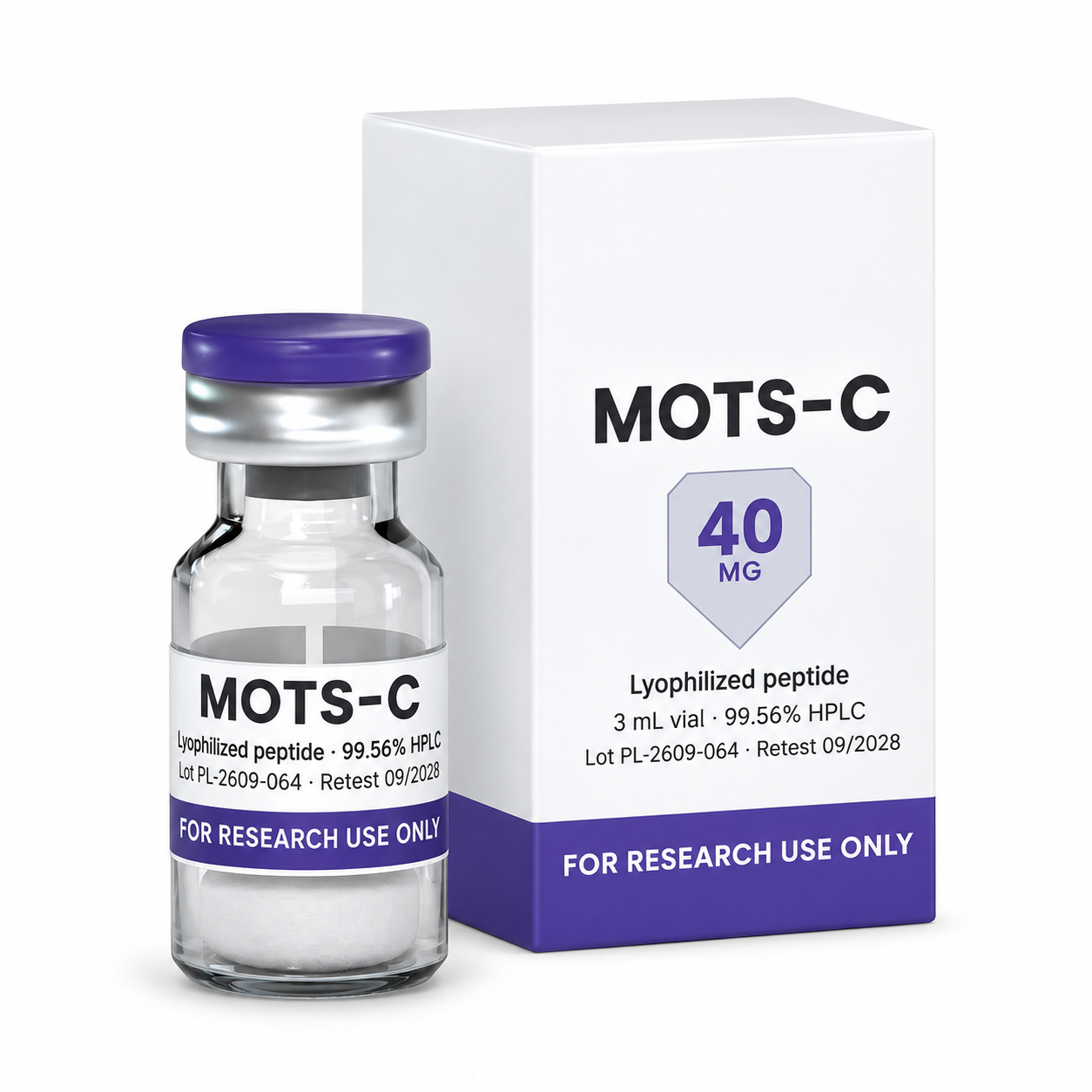
MOTS-C 40 mg vial
Freeze-dried MOTS-C with the matching report for lot PL-2609-064. Reconstitution sets the working concentration.
- Contents
- 40 mg · dry powder
- Container
- 3 mL vial
- Preparation
- Reconstitution required
- Storage
- −20°C (−4°F) · dry and dark
Powder lot PL-2609-064: 99.56% HPLC area purity. The report does not include a quantitative mg-per-vial content assay.
 PRODUCT IMAGE
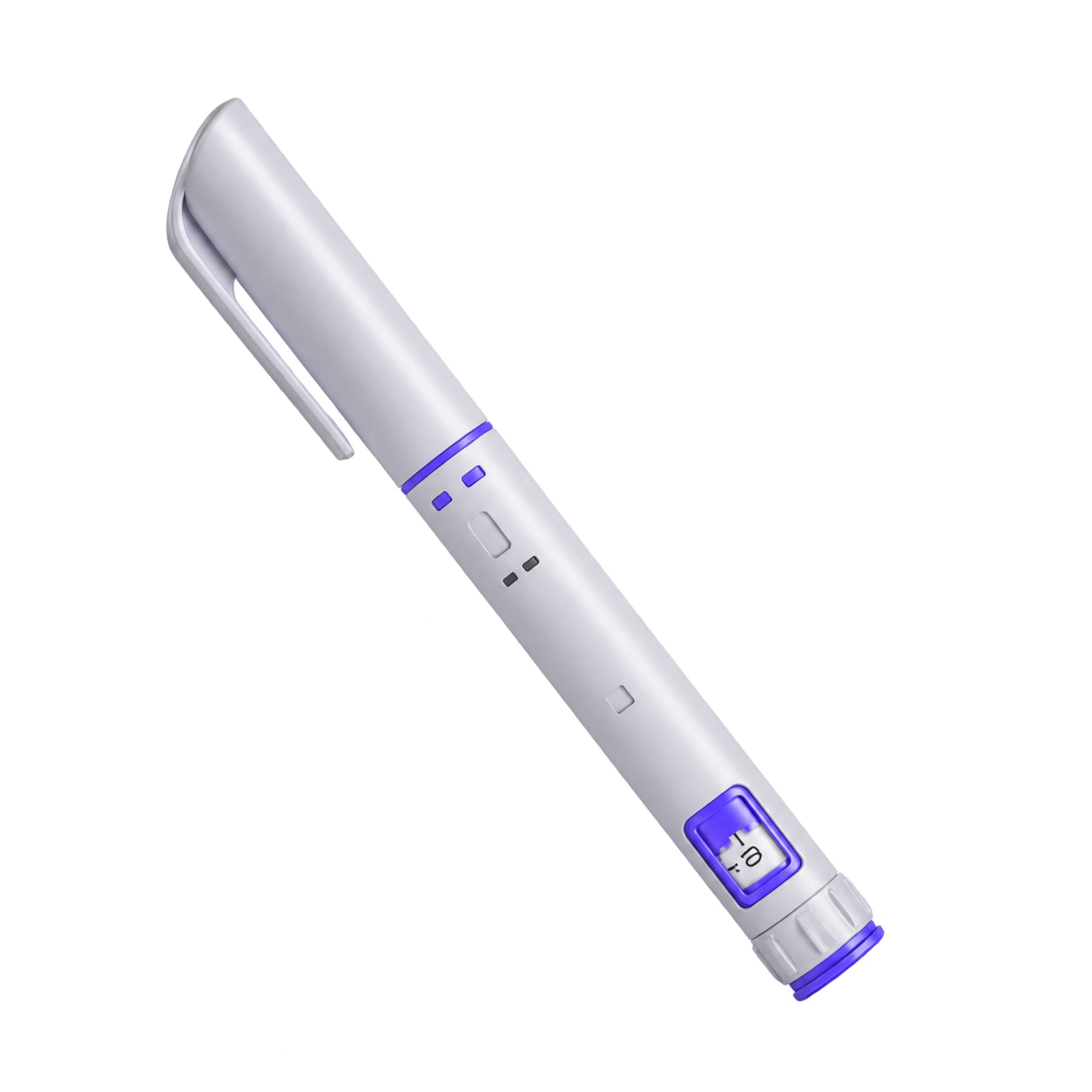
MOTS-C 30 mg prefilled pen
3 mL of prepared MOTS-C solution at 10 mg/mL, with no powder-mixing step.
- Cartridge
- 3 mL · 10 mg/mL
- Solution
- Water + 0.9% benzyl alcohol
- Preparation
- Already mixed
- Storage
- 2–8°C (36–46°F) · do not freeze
Batch COA pending.
Product photographs edited to remove supplier branding.
| Compare | 40 mg vial | 30 mg pen |
|---|---|---|
| Total MOTS-C | 40 mg | 30 mg |
| Supplied form | Freeze-dried powder | Prepared aqueous solution |
| Container | 3 mL glass vial | 3 mL glass cartridge in a pen |
| Concentration | Set by final solution volume | 10 mg/mL |
| Preparation | Reconstitution required | Already mixed |
| Storage as supplied | −20°C, dry and dark | 2–8°C, protected from light; do not freeze |
| Supplied batch report | Lot PL-2609-064 | Separate format from the tested powder lot |
Both formats name the same 16-amino-acid ingredient. A larger milligram total describes how much material the container holds; it does not describe a stronger effect, a longer treatment course or better results. For the biological background, read the MOTS-C guide. For quantity and volume calculations, go to the dosage and preparation page.
MOTS-C 40 mg powder vial
The vial holds 40 mg of lyophilized MOTS-C in a 3 mL container. Lyophilized means freeze-dried: the supplied contents are powder. The matching certificate identifies lot PL-2609-064 and reports 99.56% HPLC area purity. [1] [2]
The container size and the prepared solution volume are different measurements. Concentration comes from the amount of MOTS-C divided by the final liquid volume. For example, 40 mg in a final 2 mL gives 20 mg/mL. In a final 1 mL, the same 40 mg gives 40 mg/mL. Changing the volume changes the concentration while keeping the total amount of peptide the same.
The powder format allows a working concentration to be selected during preparation. That flexibility is useful when comparing liquid volumes or planning a defined laboratory preparation. It also introduces a mixing step and separate handling supplies. Include those supplies when comparing the overall cost of the vial and pen.
Keep the lot number with the prepared container so its identity remains linked to the batch report. Record the preparation date, final volume and resulting concentration together. The MOTS-C vial calculator uses those quantities to calculate a selected amount in millilitres and U-100 syringe units.
MOTS-C 30 mg prefilled pen
The pen contains 3 mL at 10 mg/mL, giving 30 mg in total. Its formulation contains MOTS-C in bacteriostatic water with 0.9% benzyl alcohol. It is already dissolved, so there is no powder-reconstitution step or water to add. [1]
The pen's concentration stays fixed as the liquid is used. Each millilitre contains 10 mg; half a millilitre contains 5 mg. The label may also express this as 1% weight by volume, which means 1 gram per 100 mL and is the same concentration as 10 mg/mL.
For a buyer, the main convenience is receiving prepared solution in its delivery device. The tradeoff is a smaller total quantity than the vial and less flexibility over concentration. The supplied solution also contains a preservative, so include the complete formulation when comparing formats. Follow the device's own operating instructions for its controls, priming and handling.
The pen holds three quarters of the MOTS-C in one 40 mg vial. Conversely, the vial contains one third more peptide than the pen. These are quantity comparisons; choosing a format still depends on the intended preparation and the amount required.
Compare milligrams and liquid volume
Milligrams measure the amount of MOTS-C; millilitres measure liquid volume. To calculate volume, divide the selected milligrams by the concentration in mg/mL. This makes it possible to compare the prepared pen with a vial at a chosen concentration without treating their volumes as interchangeable.
| MOTS-C amount | Vial example: 20 mg/mL | Pen: 10 mg/mL |
|---|---|---|
| 1 mg | 0.05 mL | 0.1 mL |
| 2.5 mg | 0.125 mL | 0.25 mL |
| 5 mg | 0.25 mL | 0.5 mL |
| 10 mg | 0.5 mL | 1 mL |
In this example, the vial solution is twice as concentrated as the pen solution. The same quantity therefore occupies half the liquid volume. A smaller volume is not automatically a better choice: the preparation method and measuring equipment have to suit it. For syringe-unit conversions and a detailed explanation of final volume, use the linked calculator.
These figures explain product quantity and concentration. The selected amounts are arithmetic examples, not a recommended human dose or schedule.
How many portions are in each product?
Divide the total milligrams by the amount in each planned portion. A 40 mg vial gives eight nominal 5 mg portions; a 30 mg pen gives six. A different portion size changes the count but does not change the total peptide available.
| Amount per portion | 40 mg vial | 30 mg pen |
|---|---|---|
| 2 mg | 20 portions | 15 portions |
| 2.5 mg | 16 portions | 12 portions |
| 5 mg | 8 portions | 6 portions |
| 10 mg | 4 portions | 3 portions |
For larger quantity planning, divide the total amount needed by 40 mg for vials or 30 mg for pens and round up to a whole container. An 80 mg requirement corresponds to two vials or three pens. A 120 mg requirement corresponds to three vials or four pens. The extra pen in the 80 mg example leaves 10 mg of nominal surplus.
These counts assume the whole labelled amount is available. Liquid retained in a device, priming and preparation losses can reduce the amount recoverable. Plan a sensible allowance for the method being used. Portion count alone also does not tell you how many days a product lasts: that depends on frequency and the applicable storage period after preparation or opening.
Compare cost per milligram
For the vial, divide its price by 40. For the pen, divide its price by 30. This puts the two formats on the same quantity basis. Comparing only the price of one container can hide the 10 mg difference between them.
If a vial and pen cost the same, the vial costs 25% less per milligram. For the two formats to have the same cost per milligram, the pen would need to cost 75% of the vial price. Those relationships follow directly from the 40 mg and 30 mg totals and can be applied to any current prices.
Then account for the preparation you actually need. A vial may involve a separate compatible diluent, measuring supplies and preparation time. A pen includes the prepared formulation and device. Shipping and any required accessories affect the order total, while a quantity left unused affects the effective cost of the material you use. Compare the complete intended purchase using the same assumptions for both formats.
Preparation and storage
The two products arrive in different physical states, so their storage instructions differ. Keep sealed powder at −20°C, dry and protected from light. Keep the prepared pen refrigerated at 2–8°C in its carton, with its cap on between uses. The pen must not be frozen. [1]
Powder vial
Allow the closed cold vial to reach room temperature before opening. This reduces condensation reaching the powder. During preparation, add the compatible diluent slowly along the vial wall and avoid shaking.
Prepared pen
Keep the cartridge refrigerated and protected from light. Discard solution that has frozen or become cloudy or discoloured. A pen that contains prepared liquid should not follow the dry powder's freezer instructions.
After reconstitution, keep the vial solution at 2–8°C, protected from light, for the period established by the preparation method. The final formulation, handling conditions and container matter when setting that period. Record the preparation date and the applicable discard date on the container rather than relying on memory.
The powder lot's retest date is 5 September 2028. That date belongs to the sealed material under its stated storage conditions. It is separate from the usable period of an opened or reconstituted preparation. Keep the original batch record available alongside the preparation record, particularly if several containers or concentrations are being handled. [2]
Read the MOTS-C batch report
The supplied certificate covers the 40 mg powder vial, lot PL-2609-064. It is an in-house report for two sampled vials from a batch of 250. The displayed PDF has supplier branding and contact details removed while retaining the analytical results, dates and lot identifiers. [2]
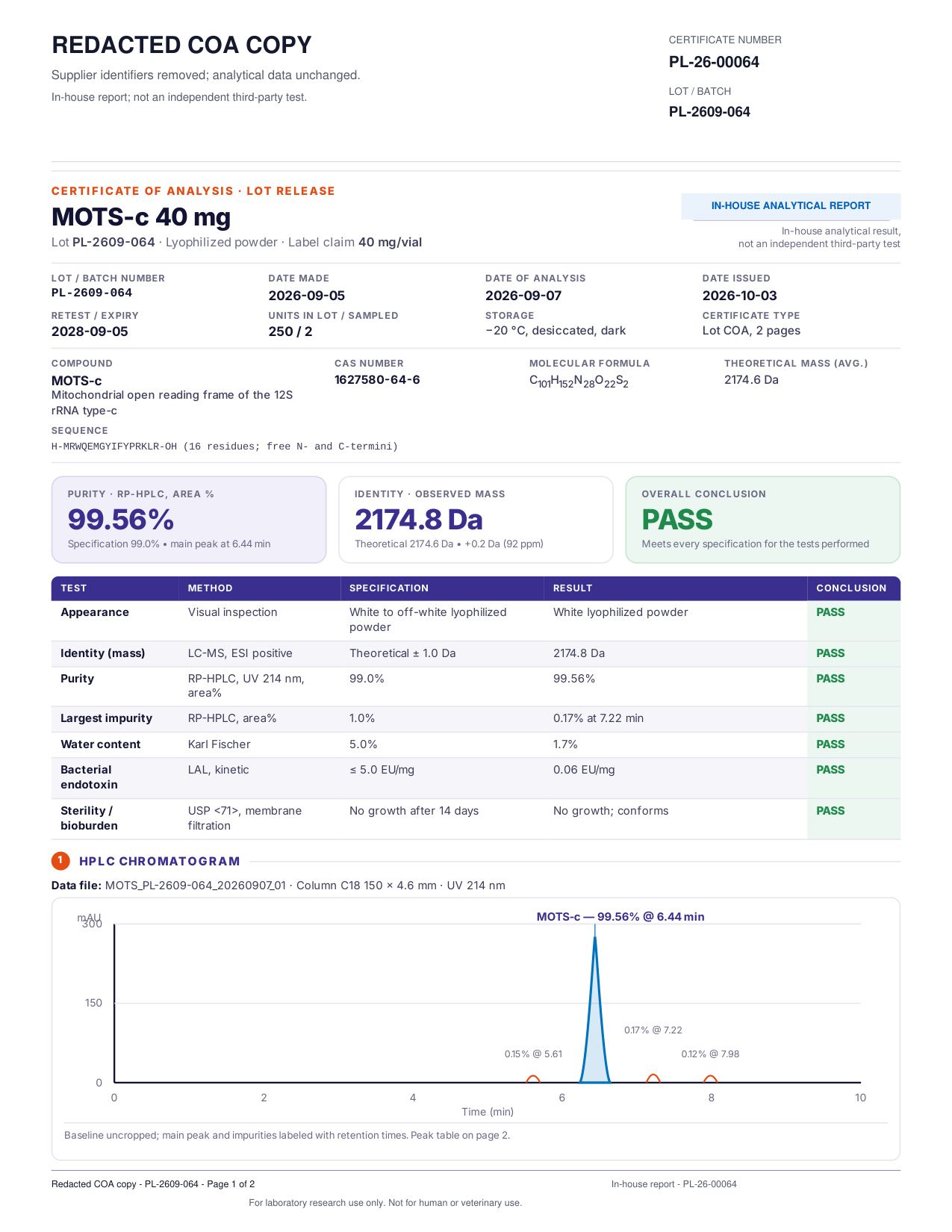
MOTS-C 40 mg — lot PL-2609-064
2 sampled powder vials from lot PL-2609-064; in-house testing. No separate quantitative vial-fill assay or finished-pen test.
Open redacted COA| Test or identifier | Reported result |
|---|---|
| Certificate | PL-26-00064 |
| RP-HPLC area purity | 99.56% |
| Main peak retention time | 6.44 minutes |
| LC-MS identity | 2,174.8 Da; theoretical mass 2,174.6 Da |
| Water by Karl Fischer | 1.7% |
| Endotoxin by kinetic LAL | 0.06 EU/mg |
| USP <71> sterility test | No growth after 14 days |
| Analysis date | 7 September 2026 |
| Report issued | 3 October 2026 |
The purity figure describes the main peak's share of the integrated HPLC signal. The printed main peak area is 4,330,860 out of a total 4,350,000, which gives 99.56%. The largest listed secondary peak is 0.17%. The LC-MS result addresses identity by comparing the measured molecular mass with the expected MOTS-C mass.
Use each result for the question it answers. HPLC area purity describes the chromatographic profile; it is separate from a quantitative milligram-per-vial assay. The vial's 40 mg figure is the label amount. Water content, endotoxin and the sterility test add different information about the sampled material. The report's scope is the powder batch, rather than a test of the filled pen cartridge or a prediction of clinical results.
For a practical comparison, keep three details together: the compound name, the lot number and the type of product tested. Here, the report and vial both identify MOTS-C and lot PL-2609-064. That gives the vial's analytical results a specific batch context while keeping the pen's formulation details separate.
Which MOTS-C format fits the purchase?
Choose the 40 mg vial when the greater total quantity and control over preparation concentration are useful. Choose the 30 mg pen when a prepared 10 mg/mL solution is the preferred format. Compare complete costs, storage needs and the amount likely to be used before deciding how many containers to order.
The benefits guide explains the findings behind metabolic and exercise claims, while the results guide separates measured outcomes from expectations. For tolerability and formulation considerations, see MOTS-C side effects.
Questions & answers.
How much MOTS-C is in the prefilled pen?
The pen contains 30 mg total: 3 mL of solution at 10 mg/mL. The same concentration can be written as 1% weight by volume. It arrives already dissolved.
Does the 40 mg vial contain liquid?
It contains freeze-dried powder in a 3 mL vial. The final liquid concentration is set during reconstitution. For example, 40 mg in a final 2 mL gives 20 mg/mL.
Which product contains more MOTS-C?
The vial contains 40 mg and the pen contains 30 mg, so the vial holds 10 mg more. That is one third more peptide than the pen. The pen holds 75% of the vial’s total.
How many 5 mg portions are in each product?
The labelled totals give eight nominal 5 mg portions from the 40 mg vial or six from the 30 mg pen. This is quantity arithmetic, with no allowance for priming or preparation losses.
Does the pen need bacteriostatic water added?
No. It already contains MOTS-C at 10 mg/mL in bacteriostatic water with 0.9% benzyl alcohol. Adding water would change the supplied formulation and concentration.
How should the vial and pen be stored?
Keep the sealed powder vial at −20°C, dry and protected from light. Refrigerate the prepared pen at 2–8°C in its carton and do not freeze it. Reconstituted vial solution follows the preparation method’s refrigerated storage and discard period.
What does 99.56% purity mean on the vial COA?
It is HPLC area purity: the main peak accounts for 99.56% of the total integrated chromatographic area. The certificate also reports identity, water, endotoxin and sterility results for sampled powder vials from lot PL-2609-064.
How do I compare value between the vial and pen?
Divide the vial price by 40 mg and the pen price by 30 mg. Then include the preparation supplies, accessories and shipping required for your order. At equal container prices, the vial costs 25% less per milligram.